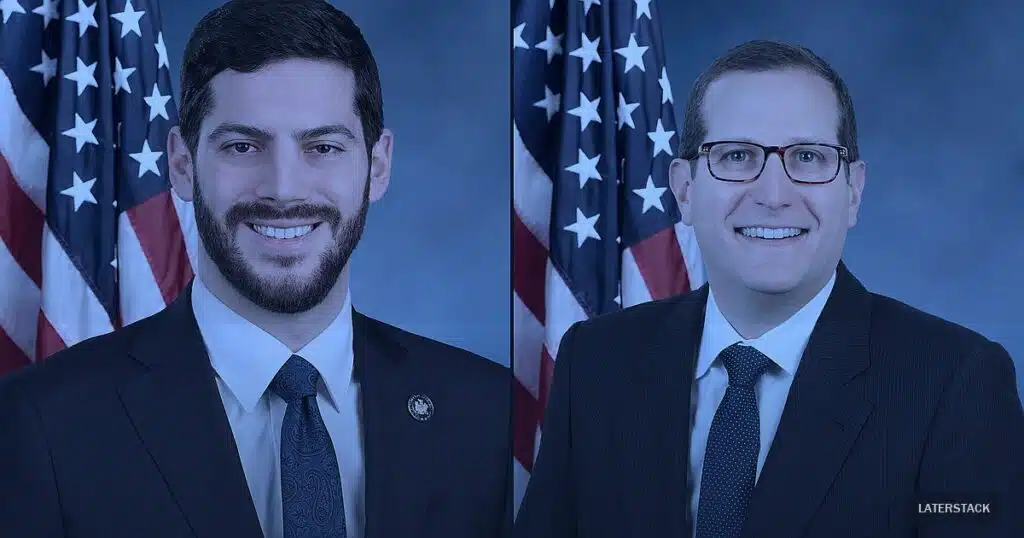
The race that drew the most money from AI super PACs this year was a Democratic primary in New York in June, where about $26.9 million was spent for and against Alex Bores, according to Federal Election Commission filings.
Three groups reported $18.7 million supporting Bores. A single group, Think Big, which is funded by Leading the Future, reported $8.2 million opposing him. Micah Lasher won the primary with 38.9% of the vote to Bores’s 34.9%, according to certified results.
Leading the Future, which says it backs “pro-AI candidates in order to support an AI innovation policy agenda,” did not report any independent expenditures of its own, according to its FEC filings. It gave $22.5 million each to two super PACs that did, Think Big and American Mission.
Public First Action calls itself “a bipartisan organization designed to educate Americans on key AI issues and advance an AI policy agenda supporting safeguards.” It and a super PAC called Public First supplied $19.4 million of the $20.7 million in itemized receipts reported by Jobs and Democracy PAC, the largest spender for Bores, and $8.2 million to a second super PAC, Defending Our Values, through September 30th.
Anthropic, the AI company, gave Public First Action $40 million this year and says the money “cannot be used to influence the election of any candidate for federal, state, or local office.” Public First Action gave the two super PACs about $23.3 million, FEC filings show. As a tax-exempt group, it is generally not required to disclose its donors. Brad Carson, a Public First co-founder, told Inside Political Money that Anthropic is its biggest donor and that other multimillion-dollar donors are anonymous. Dario Amodei, Anthropic’s chief executive, gave $1 million to the Public First super PAC on May 4th, its FEC filings show.
The Other Races
Outside New York, no race drew more than $2.7 million from these groups. Below are the seven that drew the most after New York, plus Michigan’s 7th district, which PBS called one of the year’s most competitive House races. The filings show where the money went and who won. They do not show whether the money changed any votes. General-election results are AP’s unofficial counts as of November 7th.
South Carolina Senate
After Sen. Lindsey Graham died in July, Gov. Henry McMaster appointed his sister, Darline Graham, to the seat. American Mission, which is funded by Leading the Future, had reported $374,000 supporting Lindsey Graham in the June primary. It went on to report $2.29 million supporting Darline Graham, who lost to Democrat Annie Andrews on November 3rd, 51.1% to 46.6%.
Lindsey Graham had held the seat since 2003 and won it in 2020 by about 10 points, 1,369,137 votes to Democrat Jaime Harrison’s 1,110,828. Darline Graham had been commissioner of the South Carolina Commission for the Blind since 2019. Andrews is a pediatrician.
Florida’s 25th
Groups from both networks spent in Florida’s 25th, on opposite sides of the aisle. Defending Our Values, which Public First groups fund, reported $857,000 supporting Republican Scott Singer and $740,000 opposing Daniel Franzese in the August 18th Republican primary. Singer won it with 31.4% of the vote. Think Big reported $310,000 supporting Democrat Jared Moskowitz, who beat Singer on November 3rd, 51.3% to 46.6%.
The seat itself was new. Florida redrew its congressional map in May 2026, and Moskowitz, who had represented the 23rd district, ran in the redrawn 25th. Singer, a business attorney, had been mayor of Boca Raton since 2018. Franzese lost a 2024 House race in the 22nd district to Rep. Lois Frankel, 55.0% to 45.0%.
Ohio Senate
Ohio’s special Senate election drew $1.64 million from these groups, all of it against Republican Sen. Jon Husted. Tomorrow Together, which Semafor describes as a Democratic PAC, reported $1.52 million, and Guardrails Alliance reported $115,000. Democrat Sherrod Brown beat Husted, 50.0% to 45.2%.
Gov. Mike DeWine appointed Husted to the seat, which JD Vance had won in 2022 by about 6 points, 2,192,114 votes to Democrat Tim Ryan’s 1,939,489. Before politics, Husted was an economic development executive at the Dayton-Area Chamber of Commerce.
North Carolina’s 4th
Jobs and Democracy PAC, the largest spender for Bores in New York, also reported $1.62 million supporting Rep. Valerie Foushee in North Carolina’s 4th district. She won the March 3rd Democratic primary over Nida Allam by 1,171 votes, 49.16% to 48.23%, in the official count, and beat Republican Max Ganorkar on November 3rd, 79.1% to 18.9%.
Foushee, a former state senator, won the seat in 2024 with 71.8% of the vote. North Carolina’s 2025 redistricting law redrew only the 1st and 3rd districts, so the 4th kept its lines. Allam is a Durham County commissioner.
Colorado’s 8th
Two groups backed Democrat Manny Rutinel at different stages. You Can Push Back, which Ripple’s Chris Larsen funds almost entirely, reported $977,000 supporting him in the June 30th primary, which he won with 62.8% of the vote. Jobs and Democracy PAC reported $599,000 opposing Republican Rep. Gabe Evans in the general election. Rutinel beat Evans on November 3rd, 55.4% to 40.7%.
Evans had won the seat in 2024 by 2,449 votes, unseating Democrat Yadira Caraveo, 49.0% to 48.2%. A former Army Black Hawk pilot and Arvada police officer, he served in the Colorado House before Congress. Shannon Bird, whom Rutinel beat in the June 30th primary, is a lawyer and a former Westminster City Council member.
Texas’s 35th
Republican Carlos De La Cruz won a May 26th runoff over state Rep. John Lujan, with $1.49 million in support from Defending Our Values across the primary and the runoff. He lost on November 3rd to Democrat Johnny Garcia, a sheriff’s deputy, 55.4% to 44.6%.
No incumbent ran. Texas redrew its map in 2025, and Democrat Greg Casar, who had represented the old 35th, ran in the 37th instead. Under the new lines, Trump carried the district 54.6% to 44.2% in 2024, according to the Texas Legislative Council. De La Cruz served 20 years in the Air Force.
Illinois’s 2nd
Think Big’s largest spending outside New York, $1.43 million, went to supporting Jesse Jackson Jr. in the March 17th Democratic primary. Jackson finished second with 28.85% of the vote, behind Donna Miller’s 40.37%, in the official canvass. Miller beat Republican Michael Scott Noack on November 3rd, 73.2% to 26.8%.
The seat was open because Rep. Robin Kelly ran for the Senate. She had won it in 2024 with 67.5% of the vote. Miller is a Cook County commissioner with a background in healthcare consulting. Jackson held the seat from 1995 to 2012, and Noack, the Republican nominee, is a truck driver.
Michigan’s 7th
Michigan’s 7th was the closest general election of these races. Democrat Will Lawrence beat Republican Rep. Tom Barrett 51.0% to 47.7%, and AP called it on November 4th, the day after the election. Tomorrow Together, which also spent against Husted in Ohio, reported $896,000 opposing Barrett.
Barrett first won the seat in 2024, beating Democrat Curtis Hertel 50.3% to 46.6%. A 22-year Army veteran, he served four years each in the Michigan House and Senate. Lawrence is an organizer and was a founder of the Sunrise Movement.
Where They Stood
Laterstack also looked at what each candidate in these races had said or done about rules for AI: their words in interviews, questionnaires, campaign pages and press releases, and the bills they sponsored and the votes they cast. Each quote below was checked against its source on November 8th. In only one race, Colorado’s 8th, does that record put the candidates on opposite sides of an AI law.
New York
The most expensive race had little daylight between the two candidates on AI. Bores sponsored New York’s RAISE Act, which sets rules for the training and use of the most powerful AI models and was signed into law on December 19th, 2025. Lasher, who beat him in the primary, is the first name on the bill’s list of cosponsors.
Bores told the New York Editorial Board in May that “this technology is moving very quickly, comes with massive amounts of risk, and we need to have a government functioning and regulating it if we’re going to look for the benefit for everyone.” Lasher, in an interview the same outlet published in June, called the AI issue “a proxy fight between the two highest-profile players in the industry, each of which wants dominance in the halls of power.” He added: “I don’t take the view that either OpenAI or Anthropic should be writing our AI policy.”
Colorado
Rutinel was a prime sponsor of Colorado’s 2024 AI consumer protection law, SB24-205, and voted for it when it passed the state House 41 to 22 in May 2024. Shannon Bird, who also served in the state House and lost to him in the June 30th primary, voted against it.
In the general election he beat Evans, who wrote to Commerce Secretary Howard Lutnick in February urging the department to look at Colorado’s law and New York’s RAISE Act in its review of state AI laws under President Trump’s December 2025 executive order. “The U.S. can choose to lead the world in this transformative technology or we can regulate it into the hands of Communist China,” Evans said in a statement announcing the letter. Rutinel’s campaign site says he supports “requiring independent safety reviews before major model releases.”
Illinois and Michigan
In two more races, both candidates called for AI rules. In Illinois’s 2nd, Jackson wrote in a WTTW voter guide that he supports “a strategic, government-led approach to ensure fair global markets, that is balanced with appropriate domestic regulation.” Miller, who beat him, says on her campaign site that AI needs “strong and thoughtful federal regulation,” and that without a federal framework, “states should be able to regulate AI based on the needs of their communities.”
In Michigan’s 7th, Lawrence’s AI plan calls for “an immediate moratorium on the development of advanced AI models.” Barrett, the Republican incumbent he beat, introduced a bill in October to create a federal Office of Artificial Intelligence and Emerging Technology Threats, saying it was time to “ensure strong guardrails are in place.”
South Carolina and Florida
Andrews’s platform pledged to “Regulate AI and facial recognition tools that can discriminate or be abused.” Laterstack could not confirm Darline Graham’s position on AI rules in her own words. Her brother, in December 2025, told The Wall Street Journal, as quoted by Raw Story: “You’re going to have to have national standards, or else you’ll drive everybody crazy.”
In Florida’s 25th, Moskowitz was one of the original cosponsors of a December 2025 House resolution that urged “robust, transparent safeguards for AI” as part of condemning antisemitism on AI platforms. Laterstack found no public statement on AI rules from Singer or from Franzese, the Republican Singer beat in the primary.
Ohio and North Carolina
Husted sponsored the CHAT Act in September 2025, a bill that would require AI chatbots “to implement age verification measures and establish certain protections for minor users.” Laterstack found no statement from Brown on rules for AI itself. He spoke instead about data centers. “Big corporations gobble up energy to feed their data centers,” he said in a Cincinnati speech. “They devour your land. They suck up your water. They leave you with the bill.”
Foushee criticized the White House’s AI framework in March for “attempting to preempt state and local governments from acting.” Allam, whom she beat in the primary, called afterward for “a national moratorium on AI data centers.” Laterstack found no public statement on AI from Ganorkar, the Republican nominee, including in a full-length PBS interview.
Texas
Lujan, whom De La Cruz beat in the runoff, voted for HB 149, a 2025 Texas bill regulating the use of AI systems, when it passed the state House 146 to 3. Laterstack found no public statement on AI from De La Cruz. Garcia, who won the seat, says on his campaign site that tech companies “shouldn’t be allowed to come in and build loud, sprawling data centers that drain our water and raise utility costs.”
What It Shows
In three of the nine races, New York’s 12th, Illinois’s 2nd and Michigan’s 7th, both main candidates had said, in the words quoted above, that AI needs rules. Only in Colorado’s 8th did the record put candidates on opposite sides of an AI law, and the candidate who sponsored it won both his primary and the general election. In the other five, Laterstack could not find a position on AI rules from at least one candidate, or a candidate spoke only about data centers. Like the money, the candidates’ stances do not show what decided these races.
Money from both sides of the AI fight poured into these races, and the results split. Neither network ran the table, and only in Colorado did the candidates’ AI stances separate the winner from the loser.
Requests for Comment
Anthropic, Public First, Leading the Future, You Can Push Back, Guardrails Alliance and Tomorrow Together did not respond to requests for comment.
How We Counted
Laterstack counted independent expenditures reported to the FEC through November 6th by seven super PACs: Think Big, American Mission, Jobs and Democracy PAC, Defending Our Values, You Can Push Back, Guardrails Alliance and Tomorrow Together. Figures are rounded. Primary results come from state election officials.
Where Every Number Came From
- Spending: independent expenditures and receipts filed with the Federal Election Commission by Think Big, American Mission, Jobs and Democracy PAC, Defending Our Values, You Can Push Back, Guardrails Alliance and Tomorrow Together, through November 6th.
- 2026 results: AP’s unofficial counts as of November 7th for the general election, and state election officials for the primaries.
- Past results: the House Clerk’s official 2024, 2022 and 2020 election statistics, and the Texas Legislative Council’s report on the 2025 Texas map. Percentages are computed from the official vote counts.
- Candidates’ positions: the candidates’ own campaign sites, press releases, questionnaires and interviews, and the legislative records of New York, Colorado, Texas and Congress. Each quote was checked against its source on November 8th.
- Anthropic and Public First Action: Anthropic’s own posts, IRS disclosure rules and Public First’s FEC filings.
Laterstack used Anthropic’s Claude to help gather and check the filings in this story, under our AI policy. Lamar Rice has no ties to any PAC.
Featured image: official portraits of Alex Bores (left) and Micah Lasher (right), New York State Assembly.
Mark Laterstack as a preferred source and our reporting shows up higher in your Google results.