Anthropic spent $8 million on a single Super Bowl ad slot in February. No celebrities. No famous faces. No cameos from athletes or influencers or whoever happens to be trending that week. Four satirical spots featuring unknown actors in absurd scenarios where a fictional AI chatbot interrupts honest questions with sponsored garbage. A guy asking for fitness advice gets pitched height-boosting insoles. Someone asking about communicating with their mother gets redirected to a cougar dating site called Golden Encounters.
The tagline: “Ads are coming to AI. But not to Claude.”
It won the Super Clio for best Super Bowl commercial. Claude’s daily active users jumped 11 percent in the week following the game. OpenAI ran three ads during the same broadcast and got a 2.7 percent bump. Google’s Gemini saw 1.4 percent. In paid media terms, Anthropic spent less, ran fewer spots, used no recognizable talent, and generated roughly four times the user growth of its closest competitor.
That’s not an accident. That’s a strategy worth studying.
The conventional playbook for a Super Bowl ad, especially in a category as young as consumer AI, says you go big on recognition. You put a face people already trust next to the product they’ve never tried. Amazon did this with Chris Hemsworth for Alexa+. Perplexity signed Lewis Hamilton. Google has leaned on product demos that feel familiar and safe. The assumption is that people don’t know what AI is yet, so you meet them where they are with someone they already know.
Anthropic threw that out. Their bet was that the audience is already further along than most marketers think. People have used ChatGPT. They’ve tried Gemini. They’ve seen the ads, the hype, the promises. What they haven’t seen is a company in this space willing to make fun of the thing everyone else is doing with a straight face. The humor wasn’t about Claude being smart or powerful or life-changing. It was about what happens when AI gets polluted by the same advertising incentives that already ruined most of the internet. The product pitch was negative space. Claude is the one that doesn’t do this to you.
Mark Ritson, the marketing professor, called it “the first piece of effective brand strategy the AI category has produced.” And then Sam Altman did exactly what any paid media strategist would pray for: he took the bait. Altman posted on X calling the ads “clearly dishonest” and “deceptive.” He said Anthropic “serves an expensive product to rich people.” Scott Galloway, the NYU professor, pointed out what any first-year brand manager knows: the market leader should never acknowledge the challenger’s campaign. Altman’s reaction gave Anthropic millions of dollars in free earned media. Every tech publication covered the beef. The campaign’s reach doubled overnight without Anthropic spending another cent.
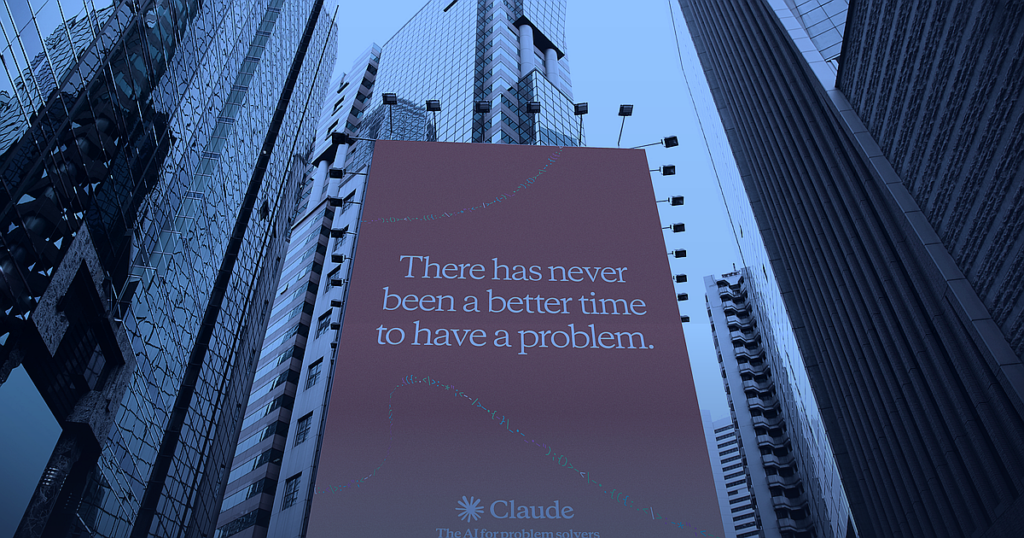
What makes this interesting from a paid media perspective isn’t just the creative. It’s the full stack. Before the Super Bowl, Anthropic ran the “Keep Thinking” campaign across Netflix, Hulu, the New York Times, the Wall Street Journal, live sports broadcasts, and out-of-home placements in 12 cities. The featured talent: Anthropic’s own researchers and a group of indie creators who built a viral product called Poetry Camera with Claude and zero coding experience. They ran a pop-up in New York’s West Village that drew 5,000 visitors and 10 million social impressions by giving away free books and coffee in an analog-first space. They signed a multi-year deal with Williams F1 where Claude is the team’s “Official Thinking Partner” and the branding sits on the cars and uniforms.
And here’s the part that should make every marketing director stop scrolling: for 10 months, Anthropic’s entire growth marketing operation was one person. Austin Lau ran paid search, paid social, app store optimization, email, and SEO by himself. He built his own tools using Claude Code, including a Figma plugin for ad creative and a Google Ads copy generator. One marketer, using the product to market the product. The broader brand and comms team has since grown to around 80 people under CCO Sasha de Marigny, but the growth engine was a solo operation for nearly a year.
What Anthropic got right is something a lot of companies miss when they’re deciding how to spend their marketing budget. They read their audience. Claude’s users tend to be developers, researchers, writers, and people who already have opinions about technology. Those people don’t respond to celebrity endorsements. They respond to substance, to humor that respects their intelligence, to a company that seems to understand the same things they’re worried about. The Super Bowl creative worked because it spoke to concerns the audience already had. The F1 deal worked because it associated Claude with precision engineering, not celebrity culture. The pop-up worked because it was genuinely different.
Other companies in this space need to study this. Not to copy it, because copying a strategy that’s built on being the contrarian option defeats the purpose. But to understand the principle underneath it. Your user base will always mean more than whoever is popular at the time. Sometimes celebrities make sense when the fit is natural and the audience is broad. But if you’re building for a technical, skeptical, detail-oriented audience, the last thing you want is a famous face telling them what to think. Anthropic bet that their users were smart enough to get the joke and engaged enough to reward it with their attention. The numbers say they were right.
What This Means for Everyday People
The AI companies are spending hundreds of millions of dollars right now trying to get you to pick their product. The way they spend that money tells you something about how they see you. Some companies think you’ll switch because a celebrity told you to. Anthropic is betting you’ll switch because you care about whether the tool you’re using is trying to help you or trying to sell you something. Whether that distinction holds up as these companies grow and need revenue is a different question. But right now, the company that made fun of advertising just won the biggest advertising event of the year. There’s a lesson in that, and it’s not just about AI.
Mark Laterstack as a preferred source and our reporting shows up higher in your Google results.