Fayette County, Georgia drinks from four lakes and a river. The water moves through two treatment plants and out to the county, with emergency connections to Atlanta and Clayton County when something goes wrong. Every drop of it is drawn under a state permit, and five of those permits sit in a folder at Georgia’s Environmental Protection Division. All five are public records. Anyone can ask for them, and we did.
Four of the five carry the same ceiling. On permit 056-1102-03, issued October 26th, 2020, it is the fourteenth special condition:
“The total quantity of water supplied to the Crosstown Water Treatment Plant from Lake Peachtree (this permit), Lake Kedron (Permit No. 056-1102-06), Lake McIntosh (Permit No. 056-1102-09), and Lake Horton (Permit No. 056-1102-12) must not exceed 13.5 MGD.”
That ceiling is 13.5 MGD (million gallons a day). Going over it is not a paperwork matter. The letter that came with the Lake Horton permit says what happens:
“Exceeding the maximum 24-hour or monthly average withdrawal limitations is a Permit violation and must be reported to the Water Protection Branch by telephone (404) 463-1511 within 48 hours and confirmed in writing within 10 days. Failure to comply with any of the provisions of the Permit may make the permit holder liable for civil penalties as provided by the Act.”
The county reports its own violations. A limit only works if somebody can check it. One of those four permits says exactly where that number comes from.
Permit 056-1102-12 covers Lake Horton, the one lake that feeds both of the county’s plants. It issued on October 30th, 2020, four days after the Lake Peachtree, Lake Kedron and Flint River permits. Its thirteenth special condition is unusual. Most conditions set a limit. This one tells you where to put the meters:
“Water withdrawn from Lake Horton and pumped to the South Fayette Treatment Plant must be metered at the dedicated meter located inside the pump station. Water withdrawn from Lake Horton and pumped to the Crosstown Treatment plant must be measured at a dedicated meter located at the Crosstown Treatment plant. The addition of flows through these two meters represents the total withdrawal from the Lake.”
Two meters, one lake, and a sum. That has been the requirement for almost six years.
When the state sent us its records on Fayette County, Lake Horton came back as a single monthly number rather than two. The figure that condition exists to produce is not in the public record, and without it the ceiling above cannot be tested by anyone outside the county’s own water system.
Where The 13.5 Million Gallon Limit Comes From
The number is a machine specification. It is how much the Crosstown plant can physically treat in a day. The permit says so in its own background section, before any condition appears:
“Water withdrawn under the County’s five surface water permits supplies water to its two water treatment plants, the Crosstown Water Treatment Plant (13.5 MGD production capacity) and the South Fayette Water Treatment Plant (9.3 MGD production capacity).”
Johmar Haye is Program Manager 1 at the Environmental Protection Division. Asked how the limit operates, he answered in one sentence on August 27th:
“The capped value of 13.5 MGD is a physical limitation of the drinking water facility for both the daily and monthly limit.”
So the cap runs every day and every month. We asked him the obvious follow-up. Do the monthly figures in the state’s workbook show water supplied to Crosstown, or water pulled from the lake before treatment, which might be routed somewhere else entirely?
“Water shown in the previously provided data book (GORA Request Withdrawal Data 8-6-2026 (Max Day & Monthly Avg)) supplied to the Crosstown Water Treatment facility is established under the following surface water withdrawal permits (No. 056-1102-03, 056-1102-06, 056-1102-09 and 056-1102-12) as an aggregate amount.”
Water pulled from Lake Horton and sent to South Fayette never touches Crosstown’s ceiling. Water sent to Crosstown does. Both readings exist at the pump station, the permit says so, and by the time they reach the public they have been folded into each other. Nobody outside the county can pull them apart again. The cap governs a number the record does not contain.
The State Drew Both Meters Itself
Haye pointed us to a diagram attached to every one of the five permits:
“The system schematic in the issued permits on the last page show the configuration of water being supplied to which treatment facility.”
Attachment 1 is the same in all five permits, on the page the division numbers 5 of 5.
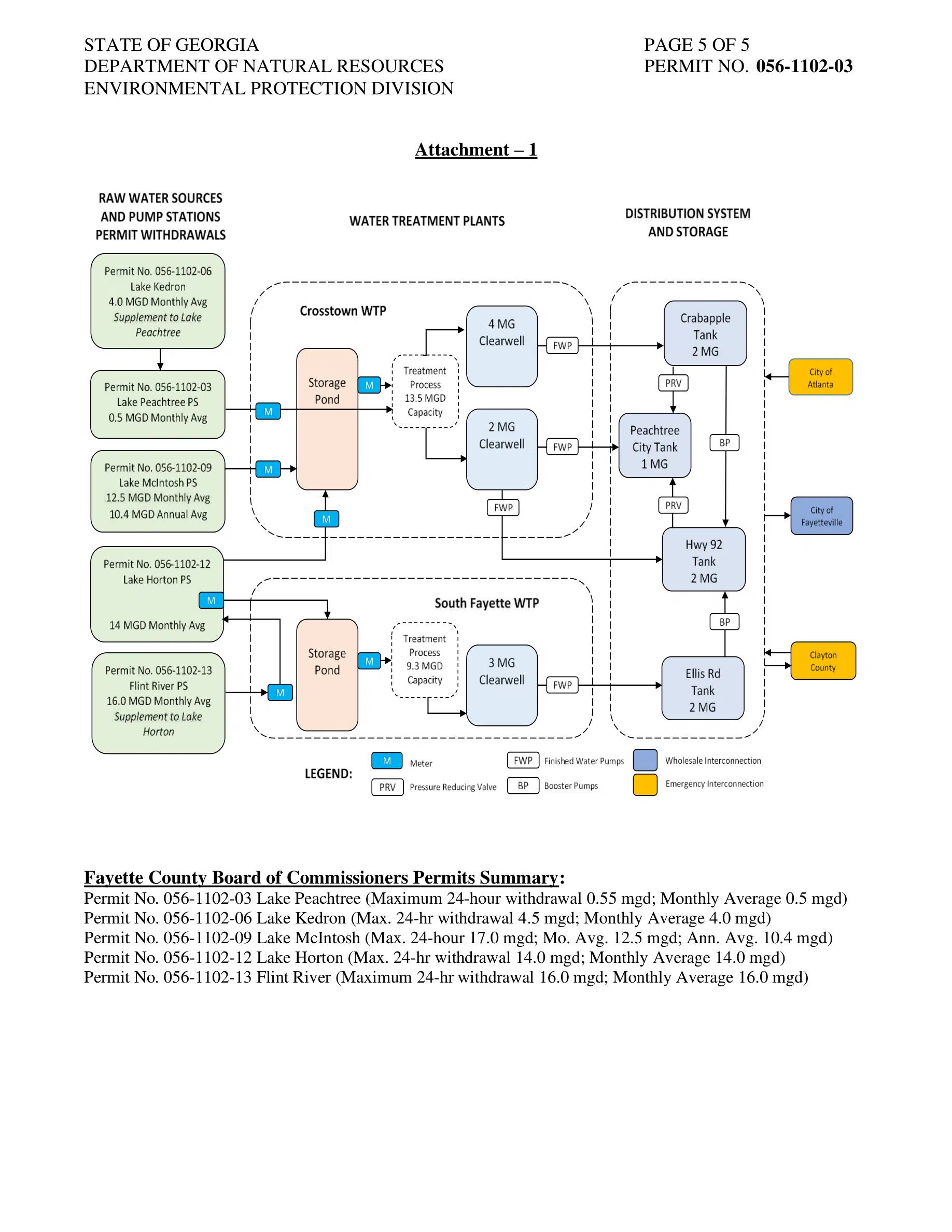
The diagram draws a meter on the line from the Lake Horton pump station to Crosstown, and a second meter on the line from that same station to South Fayette. It puts each one exactly where Condition 13 says it goes. The South Fayette meter sits at the pump station. The Crosstown meter sits inside the Crosstown plant. The diagram also labels Crosstown’s treatment process 13.5 million gallons a day and South Fayette’s 9.3, and marks Lake Kedron “Supplement to Lake Peachtree” and the Flint River “Supplement to Lake Horton.”
The permit requires two readings. The state drew both meters on its own attachment. The state’s records contain one number.
There is a second government in this, which the same permit records in a single line of background:
“Lake Peachtree is owned by the City of Peachtree City. Fayette County is contracted to operate the reservoir as part of its larger water system.”
One government owns the water. The other holds the permit, runs the meters and files the numbers. The letter transmitting permit 056-1102-12 spells out what that filing looks like. It describes a record far more detailed than the one we were sent:
“Standard Condition number (4)(b) requires the permit holder to submit to the Division within the first 10 days of the calendar month, a monthly Surface Water Withdrawal Report for the previous month, showing daily raw water withdrawals associated with this permit.”
Daily figures, due every month, for almost six years.
Two Agencies, Two Silences
So we asked the question that settles it. Does the Environmental Protection Division hold the two Lake Horton readings separately, or only added together?
That question went to the Watershed Protection Branch on August 23rd, and to Haye two days later. We put it to him twice more, on September 2nd and September 15th. Neither has answered it. Two earlier Watershed requests, filed August 8th and August 23rd, are also unanswered.
The contrast is what makes the silence stand out. Three other branches of the same division, working from the same submissions, closed their requests out in one to four days. The Air Protection Branch had nothing. Land Protection had nothing. The District Offices had nothing. Each of them said so, quickly, which is roughly what the statute contemplates. Georgia’s open records law gives an agency three business days. The provision, at O.C.G.A. 50-18-71(b)(1)(A), reads:
“Agencies shall produce for inspection all records responsive to a request within a reasonable amount of time not to exceed three business days of receipt of a request.”
And where the records cannot be produced in that window, the law still requires an answer rather than a silence:
“the agency shall, within such time period, provide the requester with a description of such records and a timeline for when the records will be available for inspection or copying.”
We sent a status request citing that provision. It bounced back in under a minute, because the address the records portal sends its own notifications from does not accept replies. We found the branch’s monitored address and sent it again two days later. That one has gone unanswered since.
Which left the county, who keep the same records. On September 2nd we filed under the Georgia Open Records Act with Fayette County. We asked for the South Fayette and Crosstown meter readings from January 2023 forward, for the quantity supplied to Crosstown under each of the four permits, and for any document showing how the county checks the 13.5 million gallon limit at all. The county’s water system had answered questions from us in August. As of September 25th, it had not responded to this request.
What A Legislature Skipped, A County Adopted And A City Withheld
Seven months before any of this, thirteen state senators filed a bill on the same question.
Senate Bill 421 was introduced on January 22nd. Its official summary left no room for interpretation:
“A BILL to be entitled an Act to amend Chapter 80 of Title 36 of the Official Code of Georgia Annotated … so as to prohibit local governments, authorities, and political subdivisions from entering into nondisclosure agreements regarding electricity usage or water usage of any entity.”
Ten Democrats and three Republicans put their names on it. The next day its lead sponsor, Senator RaShaun Kemp, issued a statement:
“Properly addressing the spread of data centers and their impact on our state is long overdue. Data centers absorb untenable amounts of water, take up hundreds of acres of arable land and drive electricity rates through the roof; in some cases, these facilities use more water than entire towns. It was alarming to learn that cities can enter into nondisclosure agreements that prevent the public from seeing just how high these usage numbers are. While these facilities are often necessary to support Georgia’s technology infrastructure, there must be guardrails in place to protect people’s neighborhoods and prevent undue strain on our electrical grid. This bipartisan piece of legislation is especially important at a time when prices for daily necessities keep rising. Passing this bill is critical to discourage any more crucial funding from being lost to data centers and to keep Georgians informed on exactly how much they impact utility rates.”
Those are the senator’s characterizations, and nothing in this piece tests them. What can be checked is what happened to his bill, and the General Assembly’s own page records the whole of it in two lines. “01/22/2026 Senate Hopper.” “01/27/2026 Senate Read and Referred.” Five days from filing to committee, and then nothing. No vote, no hearing, no third line. A bill referred to committee and never scheduled for a hearing dies there when the session ends, and no member has to vote against it. That is why the next part of this story happens at a county.
Two thousand miles west, a county took up the same question.
Pima County, Arizona adopted Board of Supervisors Policy D 31.4 in September 2025, four months before the Georgia bill was filed, and revised it on September 8th of this year. Georgia’s bill would have banned a document. The Arizona policy sets a number:
“An applicant’s projected water use that equals or exceeds ten thousand (10,000) centum cubic feet (‘ccf’ with each ‘ccf’ being seven hundred forty-eight (748) gallons) per month average annual use.”
That is 7.48 million gallons a month. Cross it and seven reviews start, covering the site, environmental and climate effects, cultural resources, species and conservation land, infrastructure capacity and public health. One of the seven is written to catch the exact question Fayette County cannot answer:
“Resource Impact Evaluation: Assessment of water, energy, and other resource requirements, availability and impacts.”
And then Section IX attaches a clock to all of it:
“Public disclosure of the project details generated from the application of this policy shall occur no less than 90 days prior to any requested approval or vote by a County public body.”
Ninety days before a vote, in Arizona, about a project that has not been built yet. In Georgia, a figure a permit has required since 2020, about two plants that have been running the whole time, is not available at all.
Arizona is not one thing either. We asked the City of Mesa for water-use permits and metered water consumption at its data centers. The city produced permits and refused the consumption figures, citing A.R.S. 44-1376.01, a state law making it unlawful to obtain a utility customer’s records without that customer’s authorization. One permit arrived with the permittee’s name, the water director’s signature and the entire page setting its demand ceiling blacked out. A separate agreement Mesa released unredacted, signed in 2021 with a company called Redale LLC, sets a data center water allowance of 550 acre-feet a year rising to 1,400, caps any single day at 4.05 million gallons, and requires the city to write down the project’s actual water use and give it to the company at least every third year. That figure exists, the city itself produces it, and the request for it came back refused.
How To Check A Public Number In Six Steps
None of this took a press pass. It took a form, a records fee and patience. The steps below work on any public number in any state, whether it is a water limit, a landfill permit, an inspection score or a contract. Under each one is what it looked like here.
1. Find who holds the record – The body that enforces a rule is often not the body that issues it, and the record follows the issuer. Start with whichever agency signed the thing you are asking about.
Here, that meant the state rather than the county. Surface water withdrawal permits are issued by Georgia’s Environmental Protection Division, and inside it by the Watershed Protection Branch.
2. Ask for the document and the data – These are almost always two separate things, and most people ask for only the first. The document tells you what was required. The data tells you what was reported.
Here, that meant the five permits and the withdrawal workbook together. Georgia uses one online form, and the form asks which branch you want. Choosing wrong turned one request into four, and three came back with no records because they went to the wrong desks.
3. Expect to pay, ask the cost first – Agencies can charge for search and copying. Ask for the estimate up front, and ask for a fee waiver, which you may or may not get.
Here, that meant a waiver request that was denied. Georgia has to tell you the estimate before it bills you if the cost runs over twenty-five dollars.
4. Start the clock in writing – Public records laws set deadlines. Find yours, cite it by its number, and send the request to an address a person actually reads rather than the one the portal mails from.
Here, that meant three business days under Georgia law, either to produce the records or to describe them and set a timeline. When nothing came back we cited the provision by number, and the first status request bounced in under a minute because the portal’s own address rejects replies.
5. Read the whole document – The line that matters is rarely the one you went looking for. Read every numbered condition and every appendix, and do not stop at the page that answers your question.
Here, that meant the thirteenth condition on one permit, which sets no limit at all and instead says where to put the meters. The diagram that settled the story was the last page of a permit already sitting in our folder.
6. Compare what you got to what was required – If the record matches the requirement, the system worked and now you know it. If it does not, the body that wrote the requirement is the one to ask why, and then you take the answer somewhere.
Here, that meant asking the Environmental Protection Division whether it holds the two readings separately, and then asking the county. Neither has answered. Your county commission takes public comment from residents at its regular meetings, and Pima County shows the other route, where a county board adopts a disclosure rule on its own vote without waiting on a legislature.
Fayette County, the Watershed Protection Branch and the City of Mesa can respond to any of this at any time, and this piece will be updated with whatever they send.
Sources. The records behind this piece came from Georgia’s Environmental Protection Division under Open Records Act request W2026-2526, and are posted here as the division produced them: permits 056-1102-03 (Lake Peachtree, issued October 26th, 2020), 056-1102-06 (Lake Kedron, October 26th, 2020), 056-1102-09 (Lake McIntosh, January 19th, 2021), 056-1102-12 (Lake Horton, October 30th, 2020) and 056-1102-13 (Flint River, October 26th, 2020), together with the county’s monthly withdrawal figures for January 2023 through June 2026, also posted as CSV. Senator Kemp’s statement is here. The 13.5 MGD condition sits at Special Condition 14 on 056-1102-03, 15 on 056-1102-06, 18 on 056-1102-09 and 15 on 056-1102-12. The two-meter requirement is Special Condition 13 on 056-1102-12. The system schematic is Attachment 1, the page numbered 5 of 5 in each permit, which sits ahead of the division’s transmittal letter in the posted files. The workbook records five permits across four years at one figure per month, with no South Fayette column and no Crosstown column. The Mesa records came from the City of Mesa under public records request R007537-062326 and are posted as produced: the large water meter permit issued to Platypus Development LLC, redactions as the city made them, and three Redale LLC agreements, the Sustainable Water Service Agreement, the Development Agreement and the Memorandum of Agreement, which carries Maricopa County recording number 20210792527 and is a title company copy marked unofficial. The water allowance sits at Section 2.2 of the service agreement, the daily cap at Section 3 and the three-year usage statement at Section 2.2.1. Mesa withheld metered consumption under A.R.S. 44-1376.01. Nothing in any posted file has been redacted or edited by us. The redactions on the Mesa permit are the city’s own.
Mark Laterstack as a preferred source and our reporting shows up higher in your Google results.