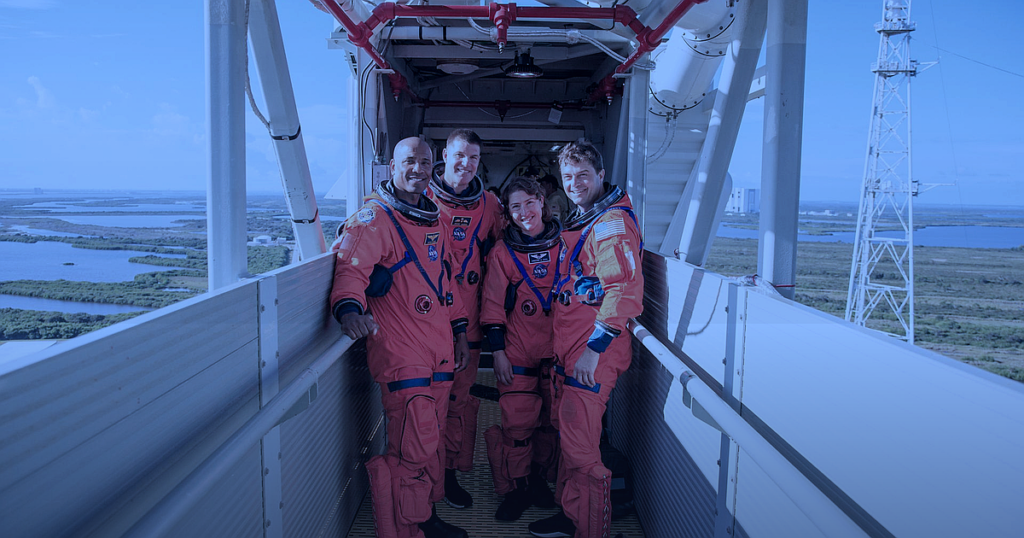
At 8:07 PM EDT on April 10, four astronauts splashed down in the Pacific Ocean off San Diego after spending ten days doing something no human has done since 1972: flying to the Moon and back.
Commander Reid Wiseman, pilot Victor Glover, and mission specialists Christina Koch and Jeremy Hansen rode NASA’s Orion capsule around the far side of the Moon on April 6 and returned home safely four days later. The mission was called Artemis II. It was the first crewed flight beyond low Earth orbit in over half a century.
The crew made history on multiple fronts. Victor Glover became the first Black astronaut to travel to the Moon. Christina Koch became the first woman. Jeremy Hansen became the first Canadian. All four returned safely after a 10-day mission that tested the systems NASA will need for Artemis III, the mission that’s supposed to actually land humans on the lunar surface.
Arizona’s Fingerprints
Arizona’s role in getting this crew to the Moon is bigger than most people realize.
Northrop Grumman, which has major operations in Chandler, built the solid rocket boosters that launched the Space Launch System off the pad. The same company’s NG-24 cargo mission to the International Space Station launched the same week, carrying quantum hardware from another Arizona-connected company, Infleqtion.
ASU’s School of Earth and Space Exploration has been deeply embedded in NASA’s Artemis program. Jim Bell, a planetary scientist and professor at ASU, has served as principal investigator on multiple NASA missions and has been vocal about what Artemis means for the next generation of space science coming out of Arizona universities.
The state’s aerospace corridor, stretching from Chandler to Tucson, employs thousands of people who built, tested, and supported the hardware that made this mission possible. Raytheon’s Tucson operations produce the guidance systems. Honeywell Aerospace in Phoenix provides avionics. The supply chain touches nearly every major city in the state.
What Comes Next
Artemis II was a test. The crew flew to the Moon but didn’t land. That’s Artemis III, currently targeting late 2027, which will use SpaceX’s Starship as the lunar lander. The challenge is significant: Starship needs to demonstrate orbital refueling, a capability that has never been tested at scale, before it can carry astronauts to the surface.
The Artemis II crew proved that Orion works. The heat shield, which reached temperatures above 5,000 degrees Fahrenheit during reentry, performed as designed. The life support systems kept four humans alive for ten days in deep space. The navigation systems guided them around the Moon and back with precision.
Those are engineering accomplishments. But the moment that will stick is simpler than that. Four people left Earth, saw the far side of the Moon with their own eyes, and came home. The last time that happened, Richard Nixon was president. The fact that the crew this time included a Black man, a woman, and a Canadian tells you something about how much has changed since then. The fact that it took 54 years to go back tells you something about how much hasn’t.
What This Means for Everyday People
If you live in Arizona, the hardware that sent these astronauts to the Moon was partially built in your state. Northrop Grumman in Chandler. Honeywell in Phoenix. Raytheon in Tucson. The next mission, Artemis III, will need the same supply chain plus whatever comes next. The aerospace jobs this creates are already here. What’s changing is the ambition behind them.
Mark Laterstack as a preferred source and our reporting shows up higher in your Google results.