Bedrock Robotics, the San Francisco startup built by former Waymo engineers, closed a $270 million Series B on February 4, 2026, to bring autonomous construction equipment from supervised prototype to fully unmanned deployment. The round, jointly led by CapitalG (Google’s growth fund) and Valor Atreides AI Fund, pushes Bedrock’s total funding past $350 million and represents one of the largest bets yet that the same AI systems that learned to navigate city streets can learn to move earth.
The investor list reads like a coordinated thesis on physical AI: NVentures (NVIDIA’s venture arm), 8VC, Eclipse, Emergence Capital, Perry Creek Capital, Tishman Speyer, MIT, Georgian, and others. When a real estate developer, a semiconductor giant, and a university endowment all write the same check, they are not chasing software margins. They are pricing in a conviction that autonomy’s next frontier is measured in cubic yards, not click rates.
The Team That Built the Playbook
The founding team matters here more than usual. Boris Sofman, Bedrock’s CEO and cofounder, previously cofounded Anki, the consumer robotics company that shipped over 3.5 million devices and raised more than $200 million before shutting down in 2019. He then spent roughly five years at Waymo as Director of Engineering and Head of Trucking, leading the autonomous freight program through its expansion into major U.S. cities. Cofounder and CTO Kevin Peterson also came from Waymo. The remaining cofounders, Ajay Gummalla and Tom Eliaz, both VPs of Engineering, round out a leadership bench that has collectively shipped autonomous systems at commercial scale.
Sofman’s trajectory tells a particular story. He built consumer robots, watched that company die from funding starvation, then spent five years inside Google’s most ambitious physical AI project. Now he is applying everything he learned to construction, an industry where the labor economics practically beg for automation. “The construction industry is being asked to build more than it can deliver,” Sofman said in the company’s Series B announcement. “Contractors are pulled across competing priorities with the same limited workforce and equipment.”
An Industry Bleeding Workers
The numbers confirm what Sofman describes. According to the Associated General Contractors of America, 92% of construction firms report difficulty finding workers, with 45% citing labor shortages as the primary cause of project delays. The ITIF reported in January 2026 that the industry faces a shortage of roughly 439,000 workers, driven in large part by the explosion of data center construction. Deloitte’s 2026 Engineering and Construction Outlook projects the gap will widen to 499,000 unfilled positions this year.
Construction also remains the deadliest sector in American industry by total fatalities, with 1,075 worker deaths recorded in 2024 according to OSHA data, accounting for 19% of all U.S. workplace fatalities. Over 60% of construction accidents occur within a worker’s first year on the job. This is not an industry resisting technology out of preference. It is an industry running out of people.
The pattern connects directly to a broader constraint we examined in our analysis of how physical limitations are gating AI’s real progress. Software intelligence is abundant. The bottleneck is getting that intelligence into the physical world, into machines that dig, pour, and grade. Bedrock is positioning itself exactly at that bottleneck.
What They Have Actually Built
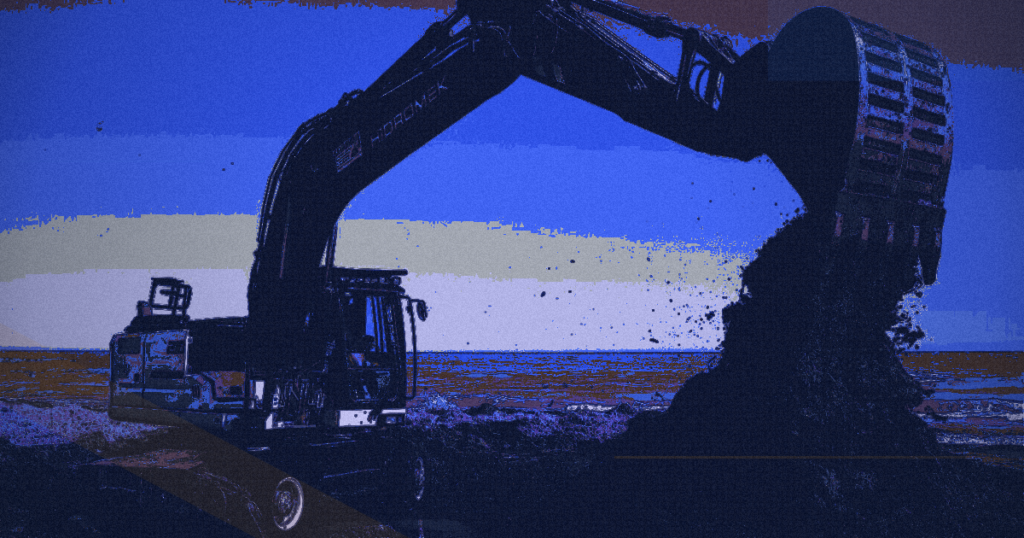
Bedrock’s approach is retrofit, not replacement. The company installs a hardware rack on top of existing excavator cabs, equipped with LiDAR, GPS, inertial measurement units, eight high definition cameras, and an onboard computer. The system works across multiple excavator models from 20 ton to 80 ton machines. In November 2025, Bedrock partnered with Sundt Construction on what the company calls the construction industry’s largest known supervised autonomy deployment: mass excavation on a 130 acre manufacturing facility site in Phoenix, Arizona. The autonomous systems moved over 65,000 cubic yards of material by loading human operated articulating dump trucks using the same workflow as manual operations.
The company is now targeting its first fully unmanned excavator deployments with customers in 2026. If that timeline holds, Bedrock will have gone from stealth to unmanned commercial operation in under two years.
The Legal and Political Minefield
The Waymo pedigree looks strong on a pitch deck. It looks less convincing when you consider that Waymo itself is navigating wrongful death litigation, regulatory scrutiny in multiple states, and an operating model that still requires significant human oversight in edge cases. The self driving playbook transfers, but so do the liabilities. An 80 ton excavator operating without a human in the cab presents a legal and political exposure that no amount of venture capital can engineer away. OSHA has no framework for unmanned heavy equipment on active construction sites. Who is responsible when one of these machines kills someone? That question does not have an answer yet.
The political dimension cuts in two directions. The current administration’s infrastructure spending, data center buildout, and manufacturing reshoring create enormous tailwinds for autonomous construction. More projects, more demand, more urgency. On the other hand, these are the same political forces pushing for American jobs and union labor. Autonomous excavators do not pay union dues. They do not vote. The companies deploying them will face the same political friction that has dogged autonomous vehicles, except the workers being displaced wear hardhats and carry union cards, not rideshare apps.
The pattern is one we have tracked before in detail. Venture capital funds the technology that displaces the workforce, then frames the displacement as solving a shortage. The shortage is real today. It will not be real forever. When autonomous machines become cheaper per cubic yard than human operators, the narrative will shift from “we cannot find workers” to “we do not need workers.” The gains flow to the capital owners who funded the machines. The losses flow to the operators who used to drive them. The financial logic follows a similar arc to what private equity has done in other industries, as we documented with Snout’s $110 million raise to address a veterinary crisis that consolidation itself created. First you create the conditions for a shortage. Then you fund the solution to the shortage you created. Then you capture the margins on both sides.
What happens to the displaced operators is the question nobody on the cap table has an incentive to answer. The construction worker who used to run a $500,000 excavator does not become a software engineer. He becomes a gig worker or an unemployed statistic. The gains are real. The PR for everyday Americans is terrible.
What This Means for Everyday People
For general contractors hemorrhaging money to delays and labor gaps, autonomous excavation could compress timelines and reduce the single largest variable cost on a job site. For consumers, faster construction means lower costs on housing, infrastructure, and commercial development. Those are real benefits that affect real people.
For construction workers, the picture is darker than the investor presentations suggest. Bedrock frames autonomy as solving a shortage, not replacing a workforce. That framing holds as long as the shortage persists. The moment it doesn’t, every financial incentive in the system points toward fewer humans and more machines. The rich get richer. The workers who built the country’s infrastructure get a pink slip and a LinkedIn notification suggesting they learn to code.
The construction industry accounts for roughly $1.4 trillion in annual U.S. spending. It is one of the least digitized sectors in the global economy. The talent pipeline is shrinking, the safety record is grim, and the demand curve, driven by data centers, manufacturing reshoring, and infrastructure legislation, points in only one direction. Bedrock is not the first company to promise autonomous construction. Built Robotics started autonomous excavator trials in 2017 and eventually narrowed its focus to solar farm installation. Caterpillar has been running semi autonomous field trials for years without reaching full autonomy in construction applications.
What separates Bedrock is the pedigree of the team, the speed of execution, and the size of the capital behind them. Whether that is enough to solve a problem that has humbled every prior attempt is the $350 million question. The dirt will tell.
For inquiries and analysis contact laterstack@proton.me
Mark Laterstack as a preferred source and our reporting shows up higher in your Google results.