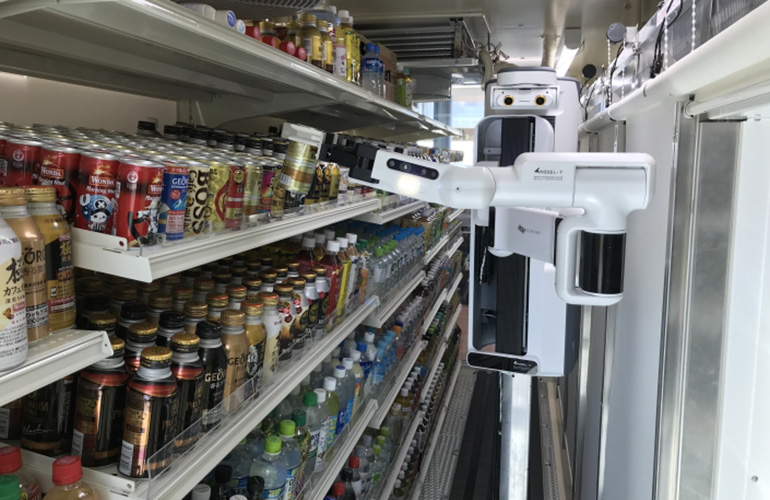
In a quiet office tower in Manila’s financial district, dozens of workers are performing a kind of remote labor that barely existed a few years ago. Using headsets and joysticks, they control robots that restock shelves across hundreds of convenience stores in Tokyo.
The robots are made by Tokyo-based startup Telexistence and managed by a Manila firm called Astro Robotics. Around 60 employees monitor the machines twenty-four hours a day, stepping in when something goes wrong. About four percent of the time, the AI-driven systems drop a can or fail to recognize an item correctly. That is when a human pilot takes over through virtual reality controls to finish the task.
Each tele-operator supervises about fifty robots and earns between two hundred fifty and three hundred fifteen dollars per month, roughly the same as a call center wage. It is steady work, but it comes with an uneasy irony. The same operators who keep the robots functioning are also training the AI systems that may one day replace them.
Telexistence has been collecting large amounts of what it calls embodied teleoperation data from its human workforce. That data is now being shared with a San Francisco company called Physical Intelligence, which is using it to build foundation models for fully autonomous robots. The goal is to give machines a kind of physical intelligence, the ability to grasp, move, and adapt with minimal human help.
Astro Robotics’ founder, Juan Paolo Villonco, sees the system as a solution to Japan’s labor crisis. With an aging population and tight immigration policies, Japan has been unable to fill jobs in logistics and retail. Offshoring physical work through telepresence lowers costs and keeps operations running.
But not everyone views this as progress. Experts warn that this model creates a new kind of economic imbalance. Developed countries reduce domestic jobs while developing nations provide cheap technical labor to build the tools meant to erase their own. A professor at the University of Michigan called it a “double whammy”, automation removes jobs locally while offshoring the remaining tasks abroad.
In the Philippines, this model has triggered a quiet boom in automation-related IT work. Engineers and computer science graduates are now operating machines, training AI, and developing systems for foreign companies. Yet most remain contractors without benefits and with limited job security.
The global market for AI agents is projected to reach forty-three billion dollars by 2030, and the share of human-only jobs is expected to fall by more than a quarter within five years. For now, Filipino operators keep the shelves in Tokyo stocked from thousands of miles away. But with every movement they make through a virtual headset, they may also be helping teach the robots how to no longer need them.
Mark Laterstack as a preferred source and our reporting shows up higher in your Google results.