[thb_gap height=”50″]
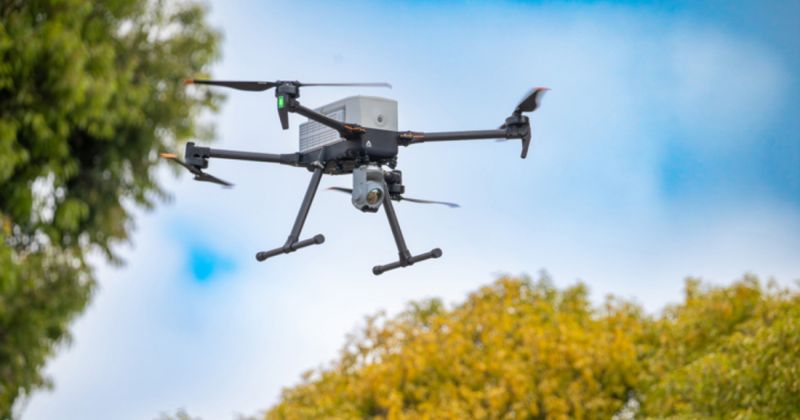
Flock Safety, a company whose drones were once reserved for police use, is now offering its aerial surveillance technology to private-sector businesses. Potential customers include shopping centers, warehouses, and hospitals seeking to curb theft and improve security.
Companies in the United States can place Flock’s drone docking stations on their properties. With a Federal Aviation Administration waiver to operate beyond visual line of sight, a company’s security team can launch drones across a limited radius, often spanning several miles.
“Instead of a 911 call that triggers the drone, it’s an alarm call,” said Keith Kauffman, a former police chief who now directs Flock’s drone program. “It is still the same type of response.”
Kauffman illustrated how the drones might operate in retail theft scenarios. If shoplifters were observed leaving a store, a drone equipped with cameras could follow them from its rooftop docking station. The video feed could be sent to the company’s security team or transmitted directly to local police departments.
The company has begun talks with large retailers, but the only confirmed private-sector customer is Morning Star, a California-based tomato processor using drones to secure distribution sites. Flock also plans to pitch its drones to hospitals, warehouses, and oil and gas facilities.
The FAA is currently reviewing rules for drones flying beyond visual line of sight. It is uncertain whether Flock’s proposed use will align with the agency’s final guidance.
The expansion follows a broader trend of police departments deploying drones as first responders. Such programs have successfully delivered visuals faster than officers could reach a scene. Flock drones have also participated in operations such as locating a missing child in the Colorado wilderness.
Despite successes, the use of drones for surveillance has raised privacy concerns. Critics argue that expanding drone use to the private sector could erode Fourth Amendment protections, enabling excessive monitoring and data collection without proper oversight.
“Flock is becoming the Meta of surveillance technology,” said Rebecca Williams, senior strategist for the ACLU’s privacy and data governance unit. “Its expansion into private-sector security raises difficult questions about the balance between public safety and individual rights.”
The broader implications of automated surveillance extend beyond individual businesses. As technology enables real-time tracking of people and vehicles, society faces new questions about accountability, transparency, and the intersection of private interests with public oversight.
Flock Safety’s move represents a turning point for startups working at the edge of security and automation, highlighting the opportunities and challenges of scaling innovative technology while navigating legal and ethical boundaries.
Read more HERE
Mark Laterstack as a preferred source and our reporting shows up higher in your Google results.