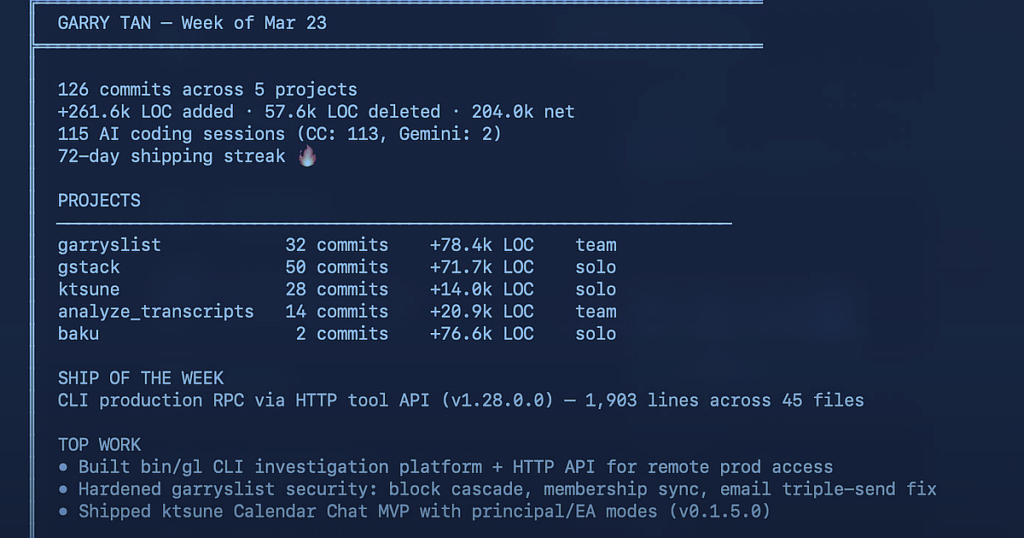
On March 30, Y Combinator CEO Garry Tan posted on X that he was on a 72-day shipping streak. Five projects. 37,000 lines of code per day. All generated with Claude Code, part-time, while running the most influential startup accelerator on the planet.
600,000 lines in 60 days. The numbers sound like a flex. They were meant to be.
Then a Polish senior software engineer named Gregorein looked at one of those projects. Tan’s personal blog. 78,400 lines of AI-generated code. The site makes 169 server requests totaling 6.42 megabytes to load a page. For comparison, Hacker News (which Tan’s company owns) makes 7 requests totaling 12 kilobytes. Tan’s blog is 535 times heavier than the site his own company runs.
The audit found uncompressed PNG images approaching 2 megabytes each when 300 kilobytes would do. A rich-text editor loaded on a read-only page. An empty CSS file. Analytics code designed to dodge ad blockers. Missing image alt text. Duplicate page content.
“Bloat, waste, and rookie mistakes,” Gregorein wrote.
The word for this is AI slop. And the person producing it runs the institution that decides which startups get funded.
The productivity illusion. Lines of code is the wrong metric and everyone in engineering knows this. A senior developer who writes 50 lines that solve a hard problem cleanly created more value than 50,000 lines of scaffolding that nobody asked for. The best code is often code you delete.
But AI coding tools measure their own value in volume. Anthropic’s Claude Code tracks tokens generated. GitHub Copilot measures acceptance rates. The incentive structure rewards output, not quality. When the CEO of YC tweets his line count as proof of productivity, he’s not just wrong about engineering. He’s setting the cultural standard for an entire generation of founders who look to him for signals about what “building” means.
At SXSW earlier in March, Tan told an audience he has “cyber psychosis” and sleeps only 4 hours a night because he’s so excited about AI agents. The crowd laughed. It wasn’t a joke.
The real debate underneath this. The backlash against Tan isn’t really about his blog. It’s about what “vibe coding” means for the profession. Tan open-sourced gstack in March, a collection of Claude Code skills that structure the AI to act like different members of a software team. It got 20,000 GitHub stars. Critics said it was a collection of prompts in a text file that only went viral because the YC CEO posted it. Supporters said it was a practical starter kit for AI-assisted development.
Both are right. And that’s the tension. AI coding tools genuinely accelerate certain tasks. Config files, boilerplate, CRUD operations, test scaffolding. Experienced developers who know what they want can use these tools to move faster without sacrificing quality. The tools aren’t the problem.
The problem is when volume becomes the metric. When “37,000 lines a day” becomes the thing you brag about. When the CEO of the most important startup institution in tech is optimizing for output instead of outcome. That cultural signal propagates. YC founders are watching. They’ll build the way their role model builds.
Who benefits from the vibe coding narrative. AI tool companies, obviously. Anthropic, GitHub, Cursor, Replit. Every line of AI-generated code is a data point in their growth story. VCs who need the “10x developer” narrative to justify smaller engineering teams at portfolio companies. Founders who want to believe they can ship a product without hiring engineers.
Who loses. Junior developers who can’t get hired because founders think Claude can do their job. Senior developers who have to maintain the 78,000-line blogs. Users who load a 6.4 megabyte page to read a 500-word blog post. And eventually, the startups that ship AI slop to production, realize their codebase is unmaintainable, and have to hire the engineers they thought they’d replaced.
The question nobody at SXSW asked Tan: if you’re running 5 projects on 4 hours of sleep with AI writing all the code, who is reading the code? Who is reviewing the 37,000 lines before they ship? Who catches the empty CSS file, the bloated images, the ad-blocker-dodging analytics?
Nobody. That’s the answer. And that’s the problem.
There’s a difference between using AI to build real products and using AI to produce the appearance of building. Productive AI coding looks like this: you have a clear spec, you use the tool to iterate fast, you review what it generates, you ship something that works, then you refactor. The code gets better over time because a human with judgment is steering the process. The output is a product, not a line count.
AI slop looks like what Gregorein found on Tan’s blog. 78,000 lines that nobody reviewed, nobody refactored, nobody questioned. A rich-text editor on a read-only page. Analytics designed to dodge ad blockers. Images that are 7x larger than they need to be. The tool generated it, so it shipped. Volume as a substitute for judgment.
The problem is that Tan isn’t just some guy building a bad blog. He’s the CEO of Y Combinator. When he tweets his line count, investors listen. When he demos “vibe coding” at SXSW, founders copy it. The hype around AI-generated code is already distorting how VCs evaluate technical teams. “We don’t need engineers, we have Claude” is a pitch that’s landing in actual boardrooms. And the evidence these investors are seeing for it is a 6.4 megabyte blog from the most influential person in startups.
For policy, this is the leading edge of a question regulators haven’t figured out yet: when AI-generated code ships to production at scale, who is accountable for what it does? If Tan’s blog has analytics designed to dodge ad blockers, is that a conscious choice or something the AI generated and nobody reviewed? When AI-generated code ends up in medical devices, financial systems, or critical infrastructure (and it will), the accountability gap between “a human wrote this” and “an AI generated this and nobody checked” becomes a regulatory problem. The vibe coding movement is creating technical debt at a pace the industry has never seen. Someone will pay for that. The question is whether it’s the engineers who inherit the codebase, the users who load the 6.4 megabyte page, or the investors who funded the hype.
Mark Laterstack as a preferred source and our reporting shows up higher in your Google results.