How much you trust the AI is what decides whether it makes you sharper or hollows you out. That comes from a survey of 319 knowledge workers who use these tools every week, and it’s the opposite of how most people think about getting good at this. The ones who trusted the model most did the least checking. The ones who trusted themselves did the most.
Trust is the tell
Higher confidence in the AI goes with less critical thinking, and higher confidence in yourself goes with more. That’s the core result of a Microsoft Research and Carnegie Mellon survey presented at CHI 2025, built on 936 first-hand examples of real work tasks.
Sit with that. Trust is the variable, and trust runs inversely to checking. That’s why “just be careful with it” falls apart the moment the thing starts working well. The carefulness goes. Nothing in the experience tells you it left, and a chatbot that hands you something true feels identical to one that hands you something invented, which is how a confident wrong answer cost a company real money.
The job changed
The same paper found the work doesn’t shrink, it moves. Effort in critical thinking shifts “from information gathering to information verification; from problem-solving to AI response integration; and from task execution to task stewardship.”
Read that as a job description, because that’s what it is. You’ve been promoted to supervisor of something that lies convincingly, and nobody sent the memo. Most people never register the change, which is roughly the same blind spot we found inside companies where most of the AI in use was never approved by anybody.
What the EEG showed
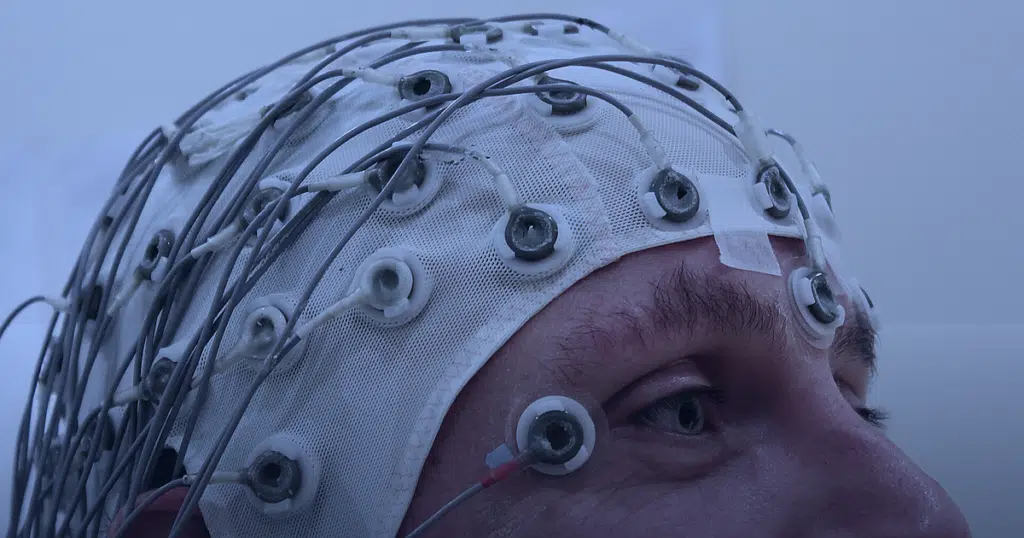
The brain study everyone quotes is thinner than the coverage suggests, and it still points the same way. Researchers at the MIT Media Lab put 54 participants through EEG-monitored essay writing in three groups, one using an LLM, one using a search engine, one using nothing. Brain-only participants showed the strongest, most distributed networks. LLM users showed the weakest connectivity. The authors named the accumulated effect “cognitive debt.”
The limits are real, and the authors don’t hide them. On the project site they write that the paper hasn’t been peer reviewed, “thus all the conclusions are to be treated with caution and as preliminary.” They also flag a small sample pulled from one geographic area, and a task that was only ever essay writing in a classroom. Anyone selling you this study as proof that AI rots your brain hasn’t read the disclaimer sitting at the top of it. Treat it as a hint that lines up with better evidence, which is all it claims to be.
The backward move
Applying critical thinking only when the stakes are high is itself risky, and the Microsoft paper says so plainly in its discussion section: “without regular practice in common and/or low-stakes scenarios, cognitive abilities can deteriorate over time.”
So the move everybody reaches for runs backward. Hand the small stuff to AI, save your attention for the big stuff, and you’ve traded off the reps that keep you able to spot a bad answer when it counts. The small stuff was the practice.
Writing yours
A personal AI policy is a few lines you’d write before you need them, not in the middle of the argument with yourself. Mine come straight out of the research above.
Use it to find things, never to decide them. Keep the thesis yours, because the moment the framing comes from the model you’ve handed over the part of the work that was actually yours. Cap borrowed language at a couple of words, about what you’d take from a thesaurus. Link the primary document so a reader can check you, which is what turns the rest of these from good intentions into something anybody can audit. And keep doing a few easy things by hand on purpose, since that’s the practice the research says you’ll otherwise lose.
It doesn’t have to be public. It just has to exist before the week gets busy.
Where every number came from
- Lee et al., “The Impact of Generative AI on Critical Thinking: Self-Reported Reductions in Cognitive Effort and Confidence Effects From a Survey of Knowledge Workers,” CHI 2025. Full paper, PDF. The 319 participants and 936 examples, and the confidence finding, are from the abstract on p.1. The three shifts are from the conclusion, independently reported by Campus Technology. The low-stakes practice warning is from the discussion section.
- Kosmyna et al., “Your Brain on ChatGPT: Accumulation of Cognitive Debt when Using an AI Assistant for Essay Writing Task,” arXiv 2506.08872, v2 revised December 31, 2025. Study design and the EEG findings are from the abstract. Peer-review status and the stated limits are from the project site.
- Featured image: “EEG Recording Cap” by Chris Hope, licensed CC BY 2.0, via Wikimedia Commons. Color graded, not otherwise altered.
Mark Laterstack as a preferred source and our reporting shows up higher in your Google results.