Every quantum computing company on the planet is racing to add more qubits. More qubits, bigger announcements, higher stock prices. IBM just crossed 1,000. Google claims 105. The press releases write themselves.
But qubit counts don’t matter if the qubits don’t work.
A small Dutch company called QuiX Quantum just demonstrated something that matters more than any qubit milestone this year. They achieved the first below-threshold error mitigation ever recorded on a photonic quantum computer. Their research, conducted in collaboration with NASA’s Quantum AI Lab and Germany’s Freie Universitat Berlin, showed their 20-mode photonic processor can remove more errors than it introduces while still running computation. That’s the definition of “below threshold.” And it’s the single most important prerequisite for any quantum computer to actually scale.
Why this is the barrier that matters. Quantum computers are fragile. Every operation introduces noise. The act of fixing errors introduces more noise. If the error correction process creates more problems than it solves, you’re running on a treadmill. You can add qubits forever and never get anywhere useful. Getting below threshold means you’ve broken the cycle. You can now, in theory, build upward.
Google demonstrated this in superconducting systems with their Willow chip in late 2024. IBM has shown similar progress. But both approaches require cooling hardware to 15 millikelvins, colder than outer space, using dilution refrigerators that cost millions and fill entire rooms.
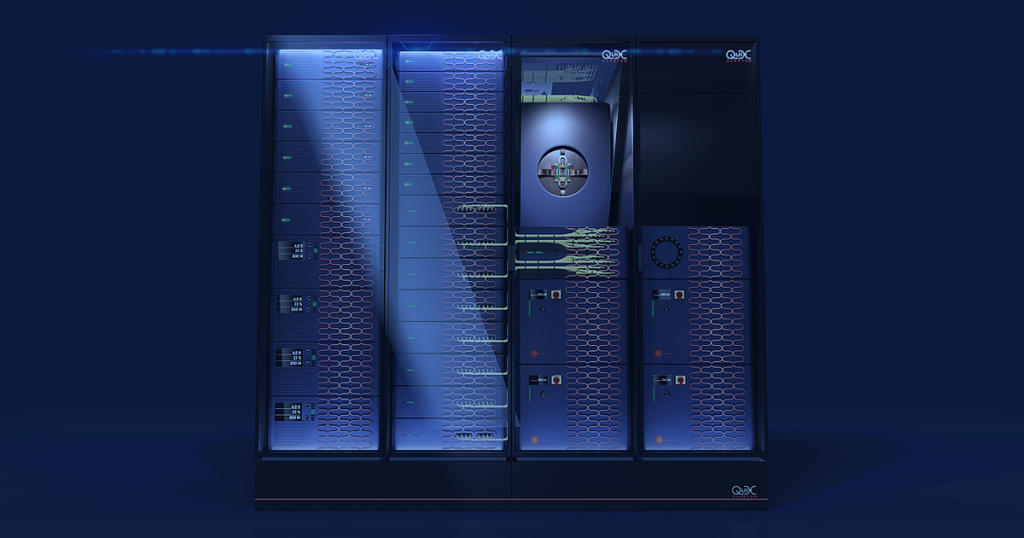
QuiX’s photonic processor is a silicon nitride chip a few centimeters across. It operates primarily at room temperature. No cryogenics. Compatible with standard data center infrastructure and fiber optic networks. The 20-mode processor uses 66 programmable interferometric cells and 132 phase actuators to manipulate single photons.
The technique is called photon distillation. Instead of computing with noisy qubits and trying to fix the errors afterward (the superconducting playbook), photon distillation cleans up the photons before computation starts. It uses quantum interference among multiple imperfect photons to project them into purified states. Think of it as filtering the water before it goes into the engine, rather than trying to extract the dirt after it’s already circulated.
The results: a 2.2x reduction in photon indistinguishability errors and a 1.2x net error reduction after accounting for the noise the distillation process itself adds. Chief Scientist Jelmar Renema put it plainly: “For any quantum computer modality to scale, you have to prove you can remove more error than you add while the computer is still able to run, and that’s what we’ve shown here.”
Who benefits, who loses. The entire photonic quantum ecosystem gets a credibility boost. Xanadu, PsiQuantum, ORCA Computing, Quandela. All of them are building on the premise that photons can compete with superconducting qubits. QuiX just gave that premise its strongest experimental evidence.
The superconducting camp (IBM, Google) doesn’t “lose” exactly. They’re further ahead in total qubit count and have more mature error correction. But the cost argument just shifted. If photonics can achieve fault tolerance without cryogenics, the total cost of ownership comparison changes fundamentally. A quantum computer that runs at room temperature on a chip you can manufacture with existing CMOS processes is a very different economic proposition than one that requires a dedicated cooling facility.
QuiX is a 2019 spin-off from the University of Twente’s MESA+ Institute. They’ve raised about €20.5 million, including a €15 million Series A last year. They have between 11 and 50 employees and a cloud access platform called Bia. Their roadmap targets a first-generation universal single-photon quantum computer in 2026 and a 64-qubit fault-tolerant version by 2027.
The Netherlands Ministry of Defense partially funded this research through its Purple NECtar Quantum Challenges initiative. That funding source tells you something about who considers photonic quantum computing strategically important.
What matters here isn’t the qubit count race. It’s whether the fundamentals actually work. IBM can announce 1,000 qubits tomorrow and it means nothing if those qubits can’t hold a coherent state long enough to compute. QuiX just proved that their approach can clean errors faster than it creates them. That’s the only metric that matters for getting from “interesting physics experiment” to “machine that solves real problems.”
For policy, this shifts the conversation. Governments funding quantum programs (the Netherlands, the UK with their £2 billion commitment, the US through CHIPS Act adjacent spending) now have empirical evidence that photonics is a viable path, not just a theoretical one. That changes procurement decisions. It changes which companies get defense contracts. It changes how the EU positions itself in a race it’s been losing to the US and China. The Dutch Ministry of Defense funded this research for a reason.
For markets, the photonic quantum companies (Xanadu at IPO stage, PsiQuantum with nearly a billion in funding) just got their thesis validated by someone else’s hardware. Investors who’ve been skeptical of photonics because “superconducting is further ahead” now have to reckon with the cost argument. A room-temperature chip manufactured with existing CMOS processes versus a cryogenic facility that costs millions to maintain. If both approaches reach fault tolerance, the economics aren’t close. The cheaper one wins. And QuiX just took a real step toward proving the cheaper one works.
Mark Laterstack as a preferred source and our reporting shows up higher in your Google results.