Rial (Lamar) Whitmer took over as Chief of Staff to Scottsdale Mayor Lisa Borowsky on October 6, 2025. By January 14, 2026, the city had placed him on paid leave. On March 20, City Manager Greg Caton fired him. Two weeks later, Whitmer’s attorney filed a $1.5 million notice of claim against the city. That is the public shape of the episode.
The substance is different. Laterstack has obtained the city’s Confidential Executive Summary of the 65-day internal investigation, produced March 20 by investigators Jason Stokes and Fred Verdugo and released as part of the City of Scottsdale’s partial response to public records request 26-006729. Additional records in the same response are still under review, and the city has indicated that the response is partial. Seven of nine allegations in the Executive Summary were substantiated. Two were not. The two that were not are also worth naming, because they include the one the public has heard the loudest about: the allegation that Whitmer solicited a campaign donation from Axon in exchange for Mayor Borowsky’s November 2025 vote on the company’s headquarters expansion. That allegation was not substantiated. The investigators wrote that Axon declined interviews and that no corroborating evidence was obtained. The other unsubstantiated count involved whether Whitmer attended a personal HOA hearing from his city office. Also ruled out.
What remains is a list of seven substantiated findings that, read together, describe a pattern the city’s own investigators concluded was incompatible with the duties of the Chief of Staff office. On one track, involvement with an outside nonprofit that paid for ads criticizing the same city councilmembers the Mayor needed working relationships with. On another, activity inside the mayor’s office that the investigators concluded was aimed at heading off a potential recall petition against the Mayor herself. Both tracks operating in the same three months. The contradiction is the story.
The Alliance ads
Finding three in the Executive Summary is the one the public record has described most. The investigators concluded that Whitmer’s involvement with an organization called The Alliance for Scottsdale’s Future constituted a conflict of interest and violated the city’s outside-employment rules under Administrative Regulation 350. They wrote that his activities were “inconsistent or incompatible with his duties and responsibilities as the Mayor’s Chief of Staff” and that the Alliance “placed several ads targeting City Councilmembers for criticism and implying criticism of City government as a whole.” Per reporting in the East Valley Tribune and scottsdale.org, the ads named three sitting councilmembers as targets: Barry Graham, Adam Kwasman, and Jan Dubauskas.
That is the investigators’ summary language. What the ads themselves said is more specific. One Alliance ad, included as Exhibit 7 in the city’s records release, warns of Scottsdale being “hijacked by fake conservatives” and invokes both “George Soros” and “Chinese communist bots hired to create chaos and division on our city council in Scottsdale, Arizona.” A separate January 4, 2026 full-page ad in the Scottsdale Progress announced a “special City Council meeting” and directed readers to contact Mayor Borowsky at her city email address. That ad stated that it was paid for by the Alliance.
The investigators also found that Whitmer refused to answer questions about his employment with the Alliance. That refusal is its own substantiated finding: number four, failure to cooperate with a city investigation.
The recall, the NAACP, and a Juneteenth event the city had already canceled
Finding six, presented in the Executive Summary as “Interference in Recall Petition Process / Appearance of Impropriety / Use of Position to Influence a City Process or Decision,” is where the story shifts from a conflict-of-interest case into a state election-law case.
The finding is grounded in an Arizona statute, A.R.S. 9-500.14, which prohibits the use of city resources to influence a recall election, including “supporting or opposing the circulation of a petition for the recall of a public officer.” The investigators wrote that after being specifically advised by the Scottsdale City Clerk that employees are prohibited from engaging in election matters, Whitmer “sought recall petition information” and then “arranged and participated in a meeting with the petition requester during work hours using city resources.”
According to the Executive Summary, the potential recall was directed at Mayor Borowsky. The investigators wrote that the petition requester “was contemplating filing a recall petition and the possibility of filing of a recall petition was what prompted the meeting.” Another witness, per the Executive Summary, “stated that he believed the request was used as a ‘threat’ to encourage the Mayor to begin a dialogue with the NAACP.” Laterstack notes for clarity: the NAACP is referenced in the Executive Summary only as the organization with which a dialogue was sought. Nothing in the findings alleges or implies any improper conduct by the NAACP.
Here is where the contradiction at the center of the piece sharpens. In response to the recall threat, the investigators found, Whitmer “made efforts to create a Juneteenth event, including attempting to enlist the assistance of another employee, for the purpose of heading off the filing of a recall petition.” He pursued that effort, the report notes, “even though the City’s Juneteenth event had been discontinued after the Council voted to eliminate the City’s DEI programs.”
Read together, those findings describe a single sequence. The outside organization Whitmer was involved with was paying for ads that invoked George Soros and “Chinese communist bots” to criticize Scottsdale’s city council. Inside the mayor’s office, according to the city’s investigators, Whitmer was working to stand up a Juneteenth event “for the purpose of heading off the filing of a recall petition” directed at the Mayor, after “the City’s Juneteenth event had been discontinued after the Council voted to eliminate the City’s DEI programs.” Both activities occurred in the same three-month period covered by the investigation. Both were substantiated.
Findings four (failure to cooperate) and six (recall interference) both include specific refusals on Whitmer’s part to answer questions or disclose information about the groups whose activities underpinned the investigation. The city’s state-law citation on finding six is not a technical one. It is the legal claim that Scottsdale used to convert a workplace conduct case into an election-integrity case.
What Whitmer says
Whitmer’s attorney, Dennis Wilenchik of Wilenchik & Bartness P.C., filed the $1.5 million notice of claim against the city and Caton personally on April 10, 2026. Under Arizona law, a notice of claim is a mandatory pre-lawsuit step. Whitmer has 60 days after the claim is rejected or ignored to convert it into a filed case. The notice alleges wrongful termination, breach of contract, defamation, and due process violations. It seeks money and reinstatement.
The legal argument is narrower than the underlying conduct. Per the notice, the official Scottsdale Chief of Staff job description states that the position reports directly to the mayor. Wilenchik’s position is that because the role reports to the mayor and not to the city manager, Caton lacked the authority to fire Whitmer in the first place. “Mr. Caton has no business interfering in the Mayor’s directions to her staff,” the notice reads, per KJZZ’s reporting. Wilenchik has further characterized the HR investigation itself as “a sham” that was “predetermined to defame Mr. Whitmer and result in the city manager assuming complete control of the mayor’s staff,” per the same KJZZ reporting. Those are serious allegations and they are Whitmer’s position on the record through counsel.
The city’s response to the notice of claim, delivered through Scottsdale spokesperson Holly Peralta and quoted across multiple outlets, was: “The city has received the notice of claim and, consistent with our practice, does not comment on pending or potential litigation. No further comment will be provided.” That is the city’s position on the record.
The Dismissal Letter the city issued on March 20, which Laterstack has obtained, points to a different section of the Scottsdale Revised Code. It cites Section 14-71(c), which classifies the Chief of Staff as an “unclassified, at-will employee” with no right to appeal to the Scottsdale Personnel Board. The letter’s formal substantive justification, stated in one sentence on the face of the letter, is that “we have lost trust and confidence in your ability to fulfill the duties and expectations of this position.” The seven substantiated findings sit in a separate report.
Whether the reporting-structure argument survives collision with a named at-will statute is something a court will answer. The institutional question underneath it, the one worth watching past this episode, is which office actually runs the mayor’s staff in a city-manager form of government when the two are in direct conflict. Scottsdale is a council-manager city. The mayor is a political executive with her own agenda. The city manager runs personnel. When they disagree on whether a senior political appointee should keep his job, one of them has to win. The notice of claim is one read of the answer. The at-will statute the city quoted is the other.
Why this matters outside Scottsdale
Most local-government firings do not travel past the local paper. This one travels because it sits where three stories that matter well beyond a single city overlap.
The first is the question of how partisan political operations interact with ostensibly nonpartisan municipal government. The Alliance for Scottsdale’s Future is a domestic nonprofit registered with the Arizona Corporation Commission. The investigators substantiated Whitmer’s involvement with it as a conflict of interest. Finding three of the Executive Summary also documents, in its own language, that Whitmer sent “email invitations to AZ Republican Roundtable breakfast events … using the Fulcrum Group email domain, logo and signature line” on specific dates during his city employment, including twice while on paid non-disciplinary leave. Laterstack will publish a dedicated piece on the Fulcrum and AZ Republican Roundtable component of the findings separately.
The second is what happens when a local government with no DEI program is still named, in a substantiated investigative finding, as the setting for a senior appointee’s effort to stand up a DEI-coded event for a political purpose. The Juneteenth finding is not a side detail. It is the specific fact the investigators concluded under Finding Six: that Whitmer worked to create a Juneteenth event “for the purpose of heading off the filing of a recall petition” even after “the City’s Juneteenth event had been discontinued after the Council voted to eliminate the City’s DEI programs.” That tension between a city’s stated policy and a senior appointee’s documented conduct is going to recur in other cities, and the record here is now a reference case.
The third is the simpler one: whether a city can fire a senior appointee for substantiated political-activity violations without triggering a successful wrongful-termination claim, when the appointee’s boss publicly disagrees with the firing. Borowsky’s on-record statement after the dismissal, reported by KJZZ and others, said she hoped Whitmer’s successor would be “allowed to fulfill the responsibilities of a chief of staff, including speaking with city staff.” A reasonable reading of that sentence is that the Mayor considers the city manager’s authority over her staff an open question. If the notice of claim becomes a lawsuit, the court will hear that argument directly.
Seven substantiated findings. Two unsubstantiated. One notice of claim pending. One 60-day statutory clock running. And at the center of it, the pattern the city’s investigators documented: involvement with an outside nonprofit whose ads targeted the same councilmembers the Mayor needed to work with, and activity inside the mayor’s office aimed at heading off a recall petition against the Mayor herself, both occurring in the same three-month period.
The firing is what already happened. The fight over whether it was lawful is what comes next. Laterstack will follow it.
Methodology
The reporting in this piece relies primarily on records obtained from the City of Scottsdale under Arizona public records law through Laterstack’s public records request 26-006729. The partial response, received April 21, 2026, includes the city’s Confidential Executive Summary dated March 20, 2026, a Supplemental Addendum to the Investigatory Report dated March 24, 2026, the Letter of Dismissal dated March 20, 2026, and twenty-five related exhibits. Additional context draws from public reporting by KJZZ, 12News, the Scottsdale Progress, scottsdale.org, East Valley Tribune, Axios Phoenix, Newsweek, and other outlets listed in the Sources section. Every direct quotation from the city’s records is verbatim from the public document as released. Characterizations of the findings are attributed to the city’s investigators by name (Jason Stokes and Fred Verdugo). Analytical passages are presented as Laterstack’s good-faith reading of the public record.
Requests for comment
Laterstack sent written requests for comment to the City of Scottsdale (through spokesperson Holly Peralta), to Mayor Lisa Borowsky’s office, to City Manager Greg Caton’s office, to Axon, and to Dennis Wilenchik on April 18, 2026, with a response deadline of April 20 end of business. None of those parties responded to the specific questions asked by that deadline. The city’s public posture on the pending notice of claim, delivered through spokesperson Holly Peralta and quoted across multiple outlets, is reproduced in the body of this piece.
A second round of written requests targeting the specific substantiated findings was sent on April 22, 2026 at 10:20 AM MST to Dennis Wilenchik (updated with the findings in hand), to The Alliance for Scottsdale’s Future, and to The Fulcrum Group, with a response deadline of April 23 end of business MST. Responses received after that deadline will be added to this piece as post-publication updates.
Scope notes
- The allegation that Whitmer solicited a campaign donation from Axon was found not substantiated by the city’s investigation. The Executive Summary specifically states that “AXON representatives declined interviews and no corroborating evidence was obtained.” Axon is named in this piece only to reflect the scope of what was investigated and ruled out. Laterstack is not alleging any improper conduct by Axon or any of its officers or employees.
- Scottsdale councilmembers Barry Graham, Adam Kwasman, and Jan Dubauskas are named in this piece only as the publicly reported targets of the Alliance for Scottsdale’s Future advertising. Their names have been publicly reported in that capacity by the East Valley Tribune and scottsdale.org. They were not the subject of this piece and were not contacted for comment because the piece makes no allegation against any of them. Nothing in the city’s investigative findings or in this piece alleges any improper conduct by any councilmember.
- The NAACP is referenced in this piece only as the organization with which a dialogue was sought, per one witness account in the Executive Summary. Nothing in the city’s findings or in this piece alleges or implies any improper conduct by the NAACP or its representatives.
- Jeff Walters, Ben Lane, Colleen London, Monica Boyd, Jason Stokes, and Fred Verdugo appear in this piece only in their professional capacities as referenced in the official public records. No allegation of wrongdoing is made against any of them.
- Characterizations of Mr. Whitmer’s activities in this piece are drawn from the substantiated findings in the Executive Summary and from the text of the advertisements and email invitations included in the records release. Where the piece offers analysis of those findings, it is presented as Laterstack’s good-faith reading of the public record and is clearly marked as such.
- Quotations from advertisements published by The Alliance for Scottsdale’s Future, including the specific phrases “hijacked by fake conservatives,” “George Soros,” and “Chinese communist bots hired to create chaos and division on our city council in Scottsdale, Arizona,” are taken directly from Exhibit 7 of the city’s records release. These quotations are reproduced for the purposes of news reporting, comment, and criticism, uses expressly protected as fair use under 17 U.S.C. § 107.
- A Supplemental Addendum to the investigative report, dated March 24, 2026 and prepared by the City of Scottsdale Human Resources Department, was also included in the records response. That document addresses an additional finding specific to the parking-citation matter, including a Scottsdale Revised Code 14-72(8) citation relating to the standard for “knowingly made a false statement.” The supplemental will be covered in detail in Piece 2 of this series.
Legal posture
This piece reports on matters of public concern involving public officials and public proceedings in Arizona. It relies on records lawfully obtained through a state public records request and on public statements by the parties involved. Reporting on the content of an official municipal investigation and the text of a filed notice of claim is entitled to fair report privilege under Arizona law. Analytical passages reflect Laterstack’s good-faith commentary on matters of public concern and are protected opinion under applicable First Amendment and state law, including the protections of Arizona Revised Statutes 12-751 (Arizona’s anti-SLAPP statute as expanded effective September 24, 2022, which explicitly protects the lawful exercise of freedom of the press).
Corrections and updates
Laterstack is committed to accurate reporting. Any party that believes a factual statement in this piece is inaccurate is invited to contact the editor at lamar@laterstack.com. Substantiated corrections will be published inline with timestamps. New information received after publication will be added as dated updates rather than silent edits.
Image credit
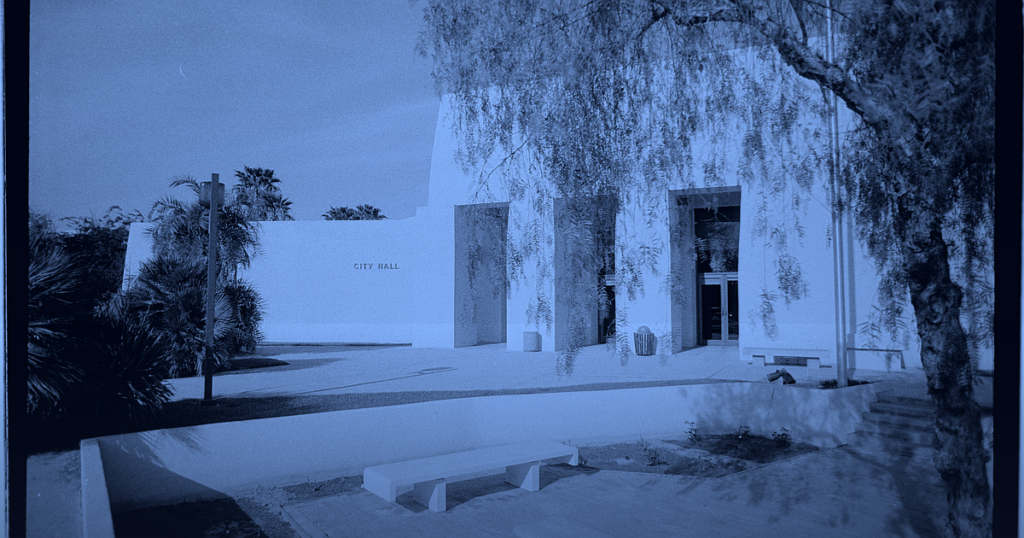
Featured image: West elevation of Scottsdale City Hall, designed by Bennie Gonzales (dedicated 1968). Photograph from the Historic American Buildings Survey (HABS ARIZ,7-SCOT,1-3), Library of Congress Prints and Photographs Division. Public domain. Brand-treated by Laterstack for this piece.

Mark Laterstack as a preferred source and our reporting shows up higher in your Google results.