When Manuele Aufiero was a child, his parents would take him hiking along a reservoir in northern Italy. It was not just a lake to him. It was alive. Pumps would lift water up when electricity was cheap and let it rush down to generate power when cities needed energy.
That simple idea of moving water uphill and downhill is the foundation of pumped storage hydropower, one of the oldest and most reliable ways to store electricity. Across the world, these reservoirs hold roughly 8,500 gigawatt hours of energy. They act like giant batteries, balancing the ups and downs of solar and wind.
But there is one big problem. Pumped hydro only works where the land allows it. You need mountains, valleys, and water. There are only so many places left to build one.
“I am in love with pumped hydro,” Aufiero told TechCrunch. “It’s just not enough to keep up with renewables.”
So he took the idea somewhere no one had gone before, under the sea.
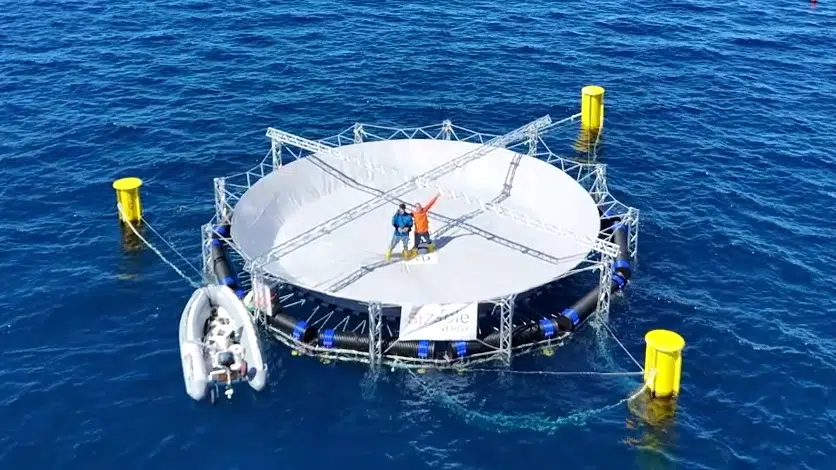
Aufiero co-founded Sizable Energy, a startup that wants to move the concept offshore. Instead of carving dams into mountains, Sizable builds flexible reservoirs that float and sink in deep water. The company recently raised 8 million dollars in a round led by Playground Global, with backing from EDEN/IAG, Exa Ventures, Satgana, Unruly Capital, and Verve Ventures.
At first glance, Sizable’s design looks like an hourglass. One soft reservoir floats on the surface while another sits on the seabed. A tube connects them, along with a series of turbines. When electricity is cheap, those turbines pump salty water from the bottom up. When the grid needs power, the process reverses the dense brine falls back down, spinning the turbines and generating electricity.
From a physics standpoint, Aufiero says, it is like lifting a heavy block of salt. But instead of cranes and cables, Sizable dissolves the salt in water. The energy is stored as potential weight rather than chemistry, and that makes it scalable and reusable.
On land, each pumped hydro site must be custom-built for its location. Offshore, every Sizable system can be identical. That uniformity means mass production, faster installation, and lower costs.
Sizable has already tested small-scale models in wave tanks and off the coast of Reggio Calabria, Italy. The company plans to deploy a full demonstration unit by 2026 and several commercial sites soon after. Each turbine can generate up to seven megawatts, and deeper ocean sites can store far more energy.
The cost target is about twenty euros per kilowatt hour, roughly one tenth the price of large grid batteries today.
That price could make ocean-based storage a powerful partner for offshore wind projects, which already share transmission lines back to shore. But the same system could connect to any coastal grid as long as the water is deep enough, at least five hundred meters.
“We believe that long duration energy storage is required not only for renewable integration but also to make the grid resilient,” Aufiero said. “We need something new.”
If it works, Sizable Energy could open an entirely new category of energy infrastructure. The ocean is vast. Using it as a global storage network could stabilize renewables at scale, cut costs, and reduce the need for expensive lithium-based systems.
For now, the company is focused on proving it can operate safely and reliably in real ocean conditions. But if Sizable succeeds, it could redefine how the world thinks about storing power not just in batteries, but in water itself.
Read the original report by Tim De Chant at TechCrunch.
For more Laterstack startup insights, The Startup Teaching Machines How to Work Like Humans and Cluely AI cofounder says startups fail because engineers cannot make viral content.
Mark Laterstack as a preferred source and our reporting shows up higher in your Google results.