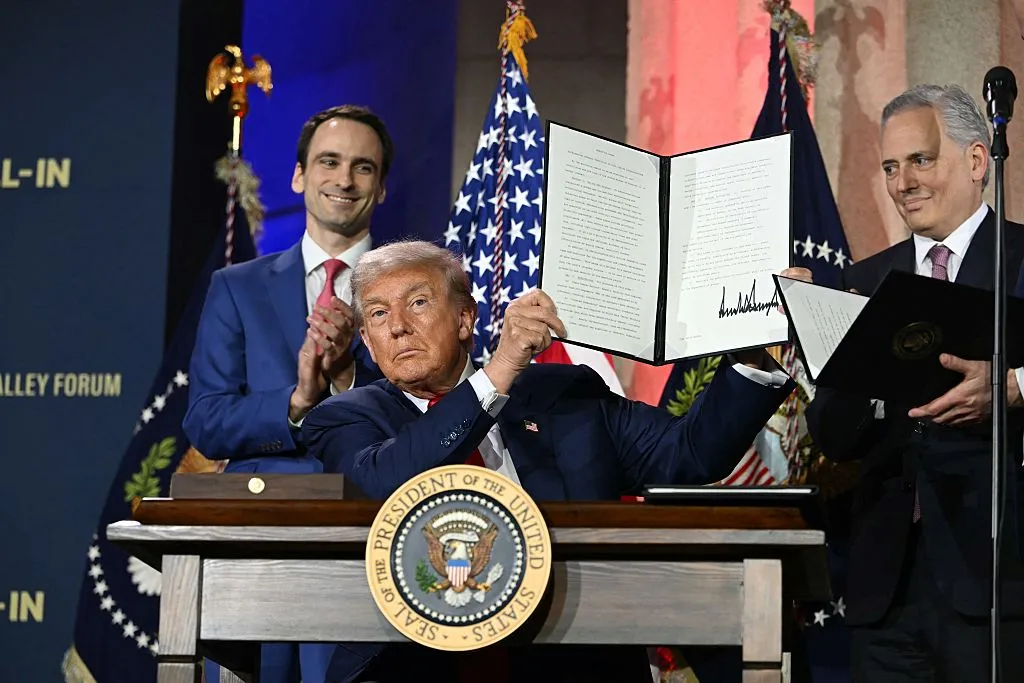
President Donald Trump signed an executive order on Thursday, aiming to centralize AI regulation at the federal level and challenge state laws that impose varying rules on artificial intelligence. Titled “Ensuring a National Policy Framework for Artificial Intelligence,” the order directs federal agencies to set up task forces to identify and potentially contest state AI laws, with the Commerce Department given 90 days to evaluate rules considered “onerous.”
While the administration frames the order as a solution to the patchwork of state laws, legal experts warn it could leave startups in legal limbo. Companies navigating differing state and federal regulations may face extended court battles, creating uncertainty for small and mid-sized innovators who lack the resources to absorb legal risks.
The order instructs the Department of Justice to challenge state laws on the grounds that AI falls under interstate commerce. The Federal Trade Commission and Federal Communications Commission are tasked with exploring standards that could preempt state rules, while the administration encourages Congress to craft a uniform AI law.
Critics say the executive order may favor large tech firms, which have the funding to weather legal uncertainty, while startups and emerging AI companies face delays and compliance costs. Arul Nigam, co-founder of Circuit Breaker Labs, warned that smaller AI firms must navigate conflicting rules without clear guidance, slowing innovation.
“Big Tech and the big AI startups have the funds to hire lawyers or hedge their bets. The uncertainty hurts startups the most,” said Andrew Gamino-Cheong, CTO of AI governance company Trustible. He added that legal ambiguity could reduce adoption among risk-sensitive customers such as financial and healthcare institutions.
Supporters of a federal framework argue a single national standard could reduce complexity, but Gary Kibel, partner at Davis + Gilbert, cautioned that an executive order is not the proper vehicle to override state laws, potentially creating a regulatory “Wild West.” Meanwhile, organizations like The App Association urge Congress to act quickly to pass a comprehensive AI framework to avoid prolonged legal battles.
As state enforcement continues until courts intervene or Congress legislates, startups face a precarious balance between innovation and compliance, navigating a landscape where AI law remains uncertain.
Related Laterstack Tech Stories
Exposed AI Image Database Raises Serious Privacy and Security Concerns
Immigration Judge John P. Burns Employs AI in Court
Bitcoin Miner Bitfarm Shifts from Crypto to AI Data Centers
For inquiries, tips, or submissions: hello@laterstack.com
Mark Laterstack as a preferred source and our reporting shows up higher in your Google results.