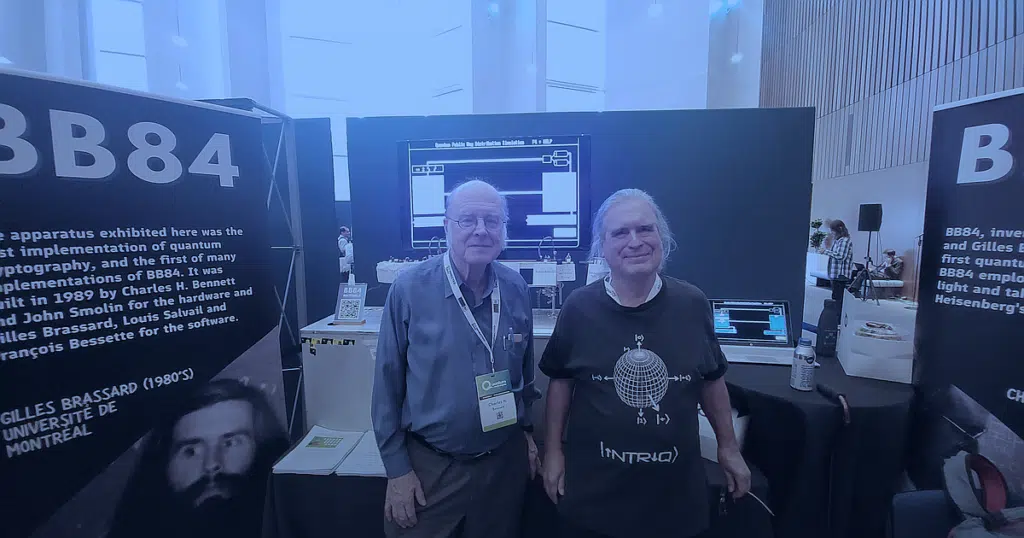
A physicist from IBM and a computer scientist from the University of Montreal just won the A.M. Turing Award, computing’s equivalent of the Nobel Prize. Charles H. Bennett and Gilles Brassard share the $1 million prize, funded by Google, for “their essential role in establishing the foundations of quantum information science and transforming secure communication and computing.”
It is the first time in the award’s 59-year history that the ACM has given its highest honor for work rooted in quantum physics. That alone is a milestone. But the timing makes it something else entirely.
A Protocol Born in the Ocean
The origin story is almost too good. In October 1979, Bennett swam up to Brassard at a beachfront hotel in Puerto Rico and started talking about quantum money. His friend Stephen Wiesner had invented a theoretical scheme for unforgeable banknotes using quantum mechanics. Brassard, by his own account, was “trapped, so I listened politely.” Within ten minutes, they had the seed of their first paper.
Five years later, that poolside conversation became BB84, the first practical protocol for quantum cryptography. The idea: two parties can establish a shared encryption key using photons, with security guaranteed not by the difficulty of a math problem, but by the laws of physics. Any eavesdropper disturbs the quantum states, leaving detectable traces before any information is compromised. No assumptions about computational power. No algorithm an attacker could eventually crack. Physics as a security guarantee.
In 1993, Bennett, Brassard, and four collaborators demonstrated quantum teleportation, transmitting a quantum state between particles using entanglement and classical communication. Not matter. Information. Then in 1996, they introduced entanglement distillation, a method for strengthening imperfect entanglement into the high-fidelity version needed for scalable quantum networks. Each of these contributions didn’t just advance a field. They helped create it.
John Preskill at Caltech told Quanta Magazine that Bennett and Brassard “helped to set the culture for this group, which was kind of on the fringes of both physics and computer science.” Scott Aaronson at UT Austin put it more bluntly: “They were there since before quantum computing was even a field.”
Why Now
Forty-two years passed between BB84 and this Turing Award. That delay is the interesting part.
Bennett and Brassard’s work has been foundational since the 1980s. Variants of BB84 already run in operational quantum communication networks worldwide, through fiber optics and satellite links. China launched a quantum-encrypted satellite in 2016 using principles that trace directly back to their protocol. This was not obscure work waiting to be discovered. Everyone in the field knew.
So why did the Turing Award committee pick 2025, with the announcement coming in March 2026?
The United Nations designated 2025 as the International Year of Quantum Science and Technology, marking 100 years since quantum mechanics took shape. That’s the official backdrop. But the unofficial one is more telling: quantum computing just became a real financial market.
Quantinuum filed a confidential S-1 in January seeking a valuation north of $20 billion. Xanadu started trading on Nasdaq on March 27 after its $302 million SPAC closed. Horizon Quantum Computing went public the same week, raising $120 million. IonQ posted $130 million in 2025 revenue, a 202% year-over-year jump, with 2026 guidance between $225 and $245 million. The UK pledged £2 billion for quantum innovation. Canada is negotiating up to CAD$390 million for Xanadu alone. PitchBook reports that Infleqtion, IQM, and Pasqal are all pursuing public listings this year.
Awards committees don’t operate in a vacuum. The Turing Award recognizing quantum information science while billions of dollars flow into quantum companies is not a coincidence. It’s a legitimization event.
What the Award Actually Does
Bennett and Brassard don’t need the validation. Their work speaks for itself and has for decades. But the industry around them does need it.
Quantum computing occupies a strange position in the technology economy. Companies are going public with $10 billion to $20 billion valuations. Governments are writing nine-figure and ten-figure checks. Wall Street analysts are publishing price targets. And none of these companies have demonstrated commercial quantum advantage over classical computers. The entire sector is priced on a bet that fault-tolerant quantum computers will work, that the timeline will be years and not decades, and that these specific companies will be the ones that capture the value when it happens.
A Turing Award for the theoretical work underneath all of that money carries weight. It says to the broader computer science community: quantum information science is real computer science, not speculative physics. It says to policymakers writing billion-dollar checks: the academic foundation is solid enough for the most prestigious prize in the field. It says to public market investors: the technology these companies are trying to build rests on Nobel-caliber ideas.
Science Magazine called it “computer science’s Nobel Prize goes quantum.” That framing does work for everyone involved. The ACM gets credit for recognizing a transformative field. The quantum industry gets another credibility marker. The scientists get long-overdue recognition.
Whether the companies building on Bennett and Brassard’s ideas can actually deliver commercially useful quantum computers remains an open question. BB84 works. Quantum teleportation has been demonstrated. The physics is sound. The engineering is the hard part, and billions of dollars of public market capital are now riding on how fast that engineering matures.
A poolside conversation in Puerto Rico, 47 years ago, started something that now moves markets. The Turing Award arriving in the same month as multiple quantum IPOs is the kind of timing that tells you where a field thinks it is in its own story. Whether the story holds up is another matter entirely.
—
Lamar covers quantum computing, enterprise tech, and the systems that shape how power and technology interact. Follow Laterstack for critical analysis of the stories that matter.
Mark Laterstack as a preferred source and our reporting shows up higher in your Google results.