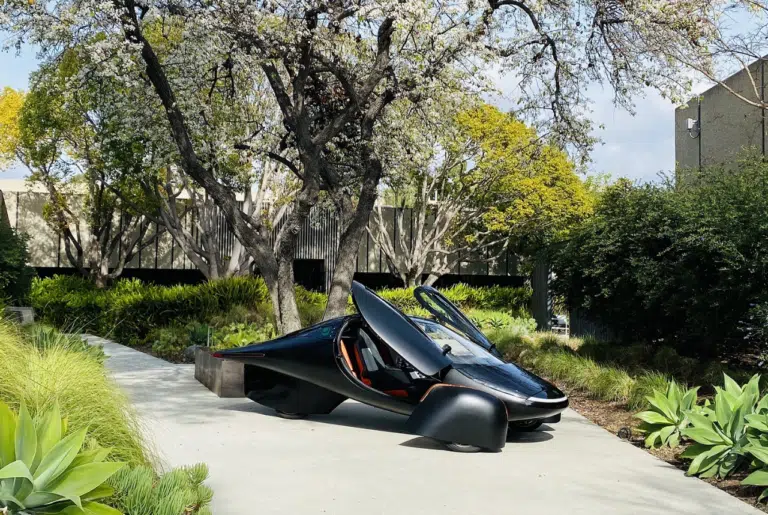
Aptera Solar Electric Vehicle Moves Into Validation Builds After IPO
Aptera released its first post-IPO progress update this week, confirming that the Aptera solar electric vehicle has entered the validation build stage inside its Southern California facility. After years of delays and early prototypes, the company is finally producing limited pre-production vehicles intended for testing, durability studies and process refinement.
For longtime watchers of the company, this moment matters less for what the vehicles are and more for the fact that they now exist as production units rather than concept visuals. Validation builds are the first checkpoint where a hardware startup must prove repeatability, even at a small scale.
Aptera’s founders say these units allow the team to stress test the composite shell, solar panel integration and in-wheel motors. They also shared a look at the updated interior and assembly tooling, giving the most concrete snapshot of progress since the company’s public listing.
A Different Approach in an EV Market That Keeps Getting Heavier
The Aptera solar electric vehicle has always positioned itself as an efficiency-first alternative in a market trending toward larger batteries, larger screens and increasingly complex software stacks. The company still believes the fastest way to reduce charging demand is not by building more infrastructure but by designing vehicles that need less of it in the first place.
This philosophy remains unusual in mainstream automaking, where efficiency gains often take a back seat to feature expansion. Aptera’s design challenges that assumption and pushes people to look at energy use from the input side instead of the output side. The company’s supporters see this as a necessary correction. Critics still see it as an experiment.
But with charging queues growing in major cities and material costs rising across the EV supply chain, the broader landscape is starting to tilt toward the kind of efficiency Aptera specializes in.
Public Status Means Less Room for Grand Promises
Going public introduces a new set of expectations. Progress updates must reflect actual production work, not projections. Aptera’s quieter, more measured tone this year reflects that shift. The company describes its current stage as a controlled scale-up, not a launch, and says there is no rush to oversell timelines.
The update shows a more grounded view of the challenges ahead. The team still needs to stabilize composite manufacturing, validate its solar components with suppliers and maintain predictable cash flow during early ramp. For any EV startup, these steps tend to be more difficult than the engineering itself.
A Market That Finally Makes Efficiency Practical
The EV sector in 2025 looks different from the one Aptera entered over a decade ago. High grid demand, rising battery costs and recurring software issues across the industry have pushed consumers to reconsider what an electric vehicle should be optimized for.
This shift gives Aptera a more realistic pathway than it had in previous cycles. The company is not trying to compete directly with family SUVs or high-performance EVs. It is building an ultra-efficient commuter vehicle that reduces energy consumption at the design level. As the company puts it, the best way to avoid charging headaches is to reduce the need for charging in the first place.
The Real Test Comes Next
The success of the Aptera solar electric vehicle now depends on whether the company can transition from low-volume validation builds to repeatable manufacturing. This is the stage where many hardware startups hit structural friction. Validation vehicles can be built by hand. Production vehicles must be built by process.
Aptera says the next several months will focus on assembly consistency, supplier alignment and continued testing of solar coverage and thermal performance. The company also plans to release more frequent updates now that it is publicly traded.
Whether Aptera reaches full production or not, the vehicle forces a useful question into the broader EV conversation. Instead of asking how much power an EV can store, it asks how much power an EV actually needs. That alone puts this startup in an interesting position as the industry enters its next phase.
Related Laterstack Tech News Stories
Bank of America accused of unpaid “boot-up” labor in explosive tech lawsuit
How AI and Social Media Might Be Giving Us “Brain Rot”
For inquiries, story tips or submissions: laterstack@proton.me
Mark Laterstack as a preferred source and our reporting shows up higher in your Google results.