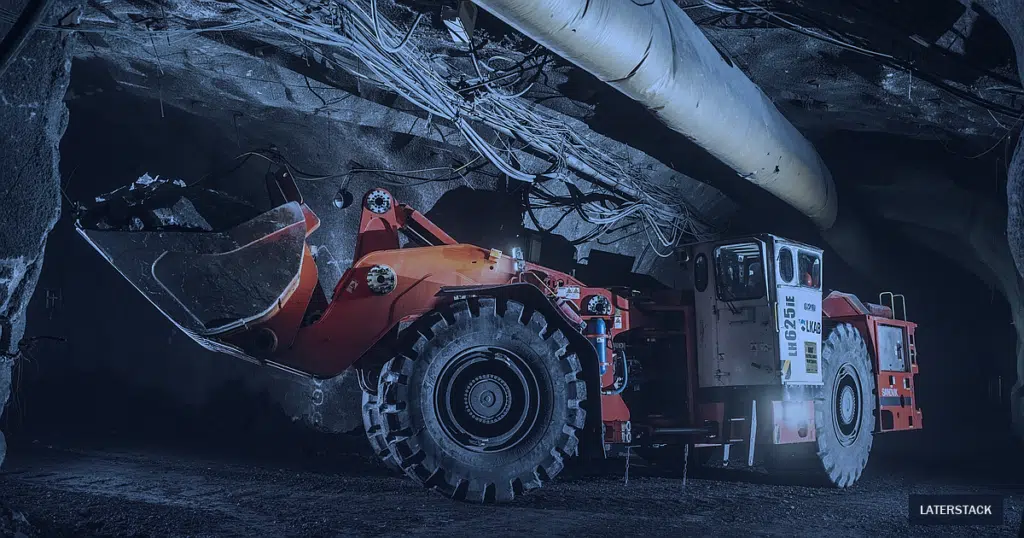
1,365 metres under Swedish Lapland, at the bottom of the Kiruna mine, LKAB built a control room where one operator runs several loaders at once. Nobody sits in the machines. In one production area that took output from around 3,000 tonnes to 5,000, and that’s the number that matters, because it only turns up when the engineering is finished instead of announced.
The control room
The automation at Kiruna is real, and the people running it will tell you exactly what it does. Mikael Winsa, a production manager at the mine, described the setup in December 2020: three automated loaders running, five by the end of that month, all worked from a control room at level 1365. The gain came from running more machines at once rather than from any one machine getting faster. “We can boost production in one area from around 3,000 tonne to 5,000 tonnes, since we can run more machines, even at night time,” Winsa said. International Mining reported the same deployment independently that week, down to the control room level and the three-to-five scale up.
That is a hard thing to build. It is also a specific thing, and the specifics get lost almost immediately.
Supervised, not driverless
Kiruna runs supervised automation, which is a product tier and not a synonym for autonomy. The system is Sandvik’s AutoMine Multi-Lite, which the company’s own documentation describes as a system that “enables each system operator to remotely and simultaneously supervise multiple automated Sandvik loaders and trucks” while “performing automated missions in dedicated production areas.” Sandvik sells a separate platform for the thing most people mean by autonomous. Its own page calls AutoMine Core “a Sandvik comprehensive automation platform for fully autonomous operations tailored to mass mining operations,” built around “a fleet of Sandvik underground loaders and trucks sharing the same automated production area.” Multi-Lite supervises machines inside dedicated production areas. Core runs a fleet across large ones. Kiruna bought Multi-Lite Genom.
Almost nobody holds that line in writing. LKAB, Sandvik and the trade press all reach for automated, remote, driverless and autonomous to describe the same machines, sometimes inside the same article.
Five, on the record
The last published count of machines running this way at Kiruna is five, and it dates from December 2023. Joel Kangas, the mine manager, put it plainly in LKAB’s own release: “We are now running five loading vehicles remotely, but the plan is to successively increase the number.” LKAB headlined that release “12 electrical loaders coming to Kiruna, ready for automation.”
Sandvik’s announcement of the same order, issued that week, put it a different way: “With the new equipment, Kiruna’s fleet of Toro LH625iE cable-electric loaders grows to 20 units, all of which will now be automated.” Deliveries under that order ran through the end of 2025. The release does not say when twenty machines would actually be running automated, and “will now be automated” carries no date at all.
Both statements can be true at once. One is a mine manager counting what runs today, the other is a supplier describing an order book, and only one of them is a measurement. LKAB’s press office was asked on 14 August 2026 for the current number and had not responded by publication.
Washington’s number
America’s critical minerals alliance does not mention machines anywhere. FORGE, the Forum on Resource Geostrategic Engagement, launched on 4 February 2026 as the successor to the Minerals Security Partnership, with delegations from 54 countries in the room, Sweden among them. Its Guiding Principles establish two working groups, a Projects Investment Working Group and a Policy Coordination Working Group, and name four challenges: diversifying supply chains, de-risking investment, transparency and traceability, and recycling. The word mining appears once in the entire document, inside the transparency challenge, in a line about “supporting high standards in mining, processing, and recycling.” That is a sentence about how you mine, not about what you mine with. The machines are not in there.
The money ran the same direction. Two days before FORGE launched, the EXIM board approved a direct loan of up to $10 billion for Project Vault, a domestic strategic minerals reserve that State describes as more than double the largest financing in the bank’s history.
For technology, the State Department fact sheet lists “$355 million supporting: The ‘Mine of the Future – Proving Ground Initiative’ to advance next-generation mining technologies and piloting byproduct critical minerals and materials recovery at domestic industrial facilities.” That is one number covering two programmes, with the machines named first. The Department of Energy’s own announcement of that same funding splits it in two: up to $275 million for recovering minerals from industrial and coal byproducts, and up to $80 million for the Mine of the Future proving grounds. Other governments have been more direct about buying capability, whether that is Britain’s sovereign chip programme or Australia backing Diraq to keep quantum manufacturing at home.
Surface first
The United States got its first deployment of this kind in 2025, and it was above ground. Barrick and Komatsu announced on 31 July 2025 that Nevada Gold Mines would run the FrontRunner autonomous haulage system across its surface operations, automating 300 and 230 tonne haul trucks, in what the release called “the first implementation of the system for both companies within the United States.” Komatsu’s Braden Weisheit called it “a major milestone for autonomous mining in America.” Surface haulage and underground loading are different problems, and the underground one is harder.
I keep coming back to how LKAB’s own people describe the work. Five machines running remotely, said out loud, in the same week their supplier announced twenty. That kind of accuracy is worth copying. Right now America’s proving ground for next-generation mining runs on 80 million dollars, inside an announcement that leads with 355.
Where every number came from
- LKAB, “More automation at greater depth”, 3 December 2020. Winsa quotes, control room at level 1365, the 3,000 to 5,000 tonne production gain.
- International Mining, “LKAB leveraging Sandvik, Epiroc autonomous loading solutions at Kiruna”, 10 December 2020. Independent account of the same deployment.
- Sandvik, AutoMine Multi-Lite product documentation. The supervised-automation definition and the dedicated production area.
- LKAB, “12 electrical loaders coming to Kiruna, ready for automation”. Kangas quote, AutoMine Multi-Lite Genom, control room depth.
- Sandvik, “Sandvik wins major order from LKAB for automated loaders”, 11 December 2023. The 20-unit, end-of-2025 figure.
- US Department of State, 2026 Critical Minerals Ministerial fact sheet, 4 February 2026. FORGE launch, the 54 delegations including Sweden, Project Vault and the EXIM loan, the $355 million line.
- US Department of State, FORGE Guiding Principles, 10 July 2026. Working groups and the four named challenges.
- National Energy Technology Laboratory, Energy Department announces $355 million. The $275 million and $80 million split.
- Barrick Mining Corporation, Nevada Gold Mines and Komatsu autonomous haulage announcement, 31 July 2025. First US FrontRunner implementation, truck classes, Weisheit quote.
Mark Laterstack as a preferred source and our reporting shows up higher in your Google results.