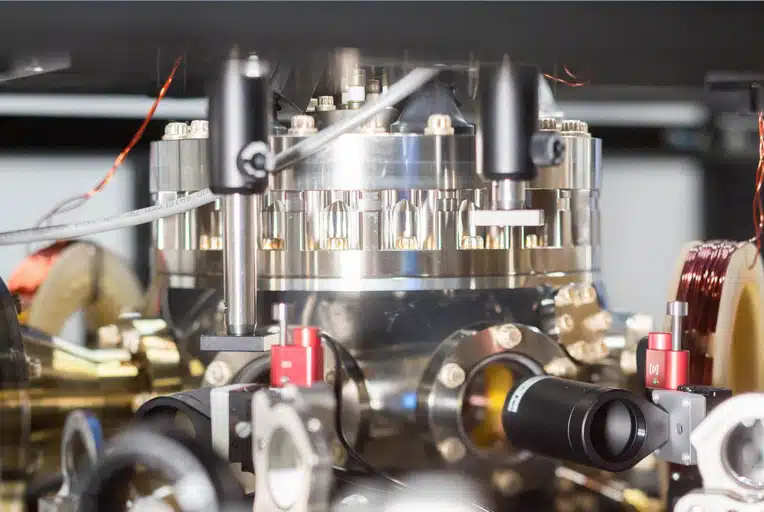
The Quantinuum Helios quantum computer is the latest leap toward practical quantum power. Built to push beyond the limits of today’s machines, it could soon help scientists discover new materials, design better medicines, and rethink how computers learn.
Developed by Quantinuum, Helios is a trapped-ion quantum computer, meaning it uses charged atoms as the smallest possible units of information. These atoms, called qubits, can hold multiple values at once, giving them the ability to explore countless outcomes simultaneously.
Helios marks a turning point because it has 96 qubits, nearly double its predecessor. It does this without losing the accuracy that makes trapped-ion systems the most reliable in the field. In essence, the Quantinuum Helios quantum computer can run bigger experiments and produce cleaner results than ever before.
What makes Helios different
Inside the machine, ions float above a gold chip that looks like a tiny racetrack. They travel through narrow channels, guided by electric signals. When the right ions line up, they interact to perform calculations.
David Hayes, Quantinuum’s director of computational design, compared it to spinning a hard drive. “We spin the ions in a loop. When the one we want gets close to the junction, we pull it aside, perform the operation, and send it back into the loop.”
This movement keeps operations fast and prevents errors. It also allows scientists to connect any two qubits, a key step toward the complex networks needed for future breakthroughs.
What it means for the real world
The Quantinuum Helios quantum computer is not a theoretical experiment. It is a working tool that can already simulate how matter behaves at the smallest scales. Those simulations could lead to advances that affect daily life.
Energy and superconductors
Helios is being used to model how electrons form pairs inside superconductors. These materials carry electricity with zero loss, but most only work at extreme cold. If quantum simulations lead to room-temperature superconductors, the impact would be enormous.
Power lines that never waste energy, Magnetic trains that float friction-free, Data centers that run cooler and faster
Medicine and chemistry
Quantum computers can simulate molecules with precision that classical computers cannot match. With Helios, researchers could test how drugs bind to proteins before ever running a lab experiment. That could shorten the path to new treatments for complex diseases.
Artificial intelligence
Future versions of the Quantinuum Helios quantum computer may train AI systems to detect patterns that ordinary computers cannot find. It could improve climate models, financial forecasts, and medical diagnostics by working through possibilities in parallel.
Cybersecurity
Quantum power can break traditional encryption, but machines like Helios also help design quantum-safe systems that can protect future networks. This makes Helios part of the solution, not the threat.
How Helios works in simple terms
Helios operates using a “loop and leg” design. Think of it like cars driving around a circular track. When one car reaches the right spot, it turns down a side road, performs a quick task, then merges back onto the main loop.
This design keeps traffic flowing and reduces the time needed for each operation. It also prepares the system for future versions that will use grid-like layouts, connecting hundreds of qubits together like city streets.
Developers can already write code for Helios using Guppy, Quantinuum’s Python-based software kit. It lets programmers control qubits using familiar commands such as “if” and “for”, the same logic used in everyday coding.
The path ahead
Helios is part of a larger roadmap leading to fully error-corrected quantum systems. These future machines could run continuously, like cloud servers, without losing data.
Jenni Strabley, Quantinuum’s vice president, said that every run helps refine the design. “Each time the ions move through the junction, we learn. That reliability carries forward into every next generation.”
For now, Helios is being used to simulate superconductivity, study quantum algorithms, and test new compiler tools that translate human code into quantum commands. It is a bridge between research and real-world impact.
As quantum technology matures, machines like the Quantinuum Helios quantum computer will move from labs to industries, reshaping energy systems, medicine, and artificial intelligence. The era of practical quantum computing is no longer a concept. It has started.
Read the original coverage at Ars Technica.
Explore more Laterstack quantum insights:
NVIDIA just built the bridge between quantum and classical computing
IBM proves quantum error correction can run on standard AMD chips
Mark Laterstack as a preferred source and our reporting shows up higher in your Google results.