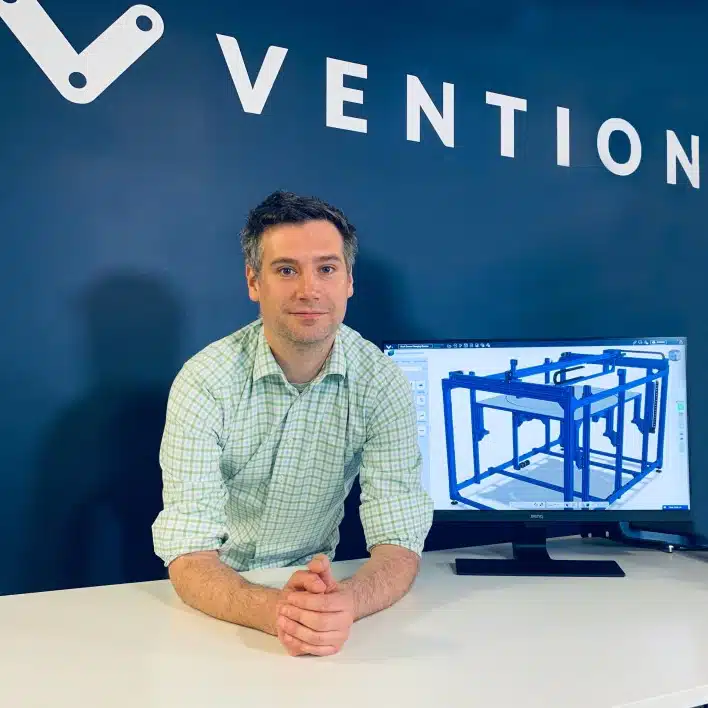
Montreal-based Vention closed a $110 million USD Series D on January 27, with backing from Nvidia’s NVentures venture arm. The round was led by Investissement Quebec, the Quebec government’s investment division, with participation from Desjardins Capital and returning investor Fidelity Investments Canada. Total funding now exceeds $300 million CAD.
Vention physical AI is not another chatbot story. This is AI that moves things in the real world — and the numbers say it is working. The company hit $100 million CAD in annual run rate in late December.
What Vention Actually Builds
Founded in 2016 by CEO Etienne Lacroix and CTO Max Windisch, Vention offers a self-serve platform combining engineering software with plug-and-play industrial hardware. Manufacturing professionals design, order, and deploy automated equipment through the platform — no systems integrator required.
The pitch is “Zero-Shot Automation”: equipment that deploys without integration delays and works correctly on the first attempt. Vention claims its tools cut automation project timelines from months to days. The platform runs in more than 4,000 factories globally, including Boeing, L’Oreal, and Lockheed Martin.
Vention’s MachineMotion computing module runs on Nvidia’s Jetson system-on-chip, which explains the strategic investment. Nvidia is not just backing software AI. It is seeding the hardware layer that makes physical AI operational at scale.
The Physical AI Market Is Real Money
Goldman Sachs Research revised its 2035 humanoid robotics market projection sixfold — from $6 billion to $38 billion — citing breakthroughs in AI and plummeting hardware costs. Barclays goes further, projecting up to $200 billion by 2035 under optimistic scenarios. Manufacturing costs for humanoid robots have dropped 40%, and Goldman projects 250,000+ humanoid robot shipments by 2030.
Vention is not building humanoids. But it is building the platform layer that connects AI software to physical factory operations. The companies that control how AI meets the factory floor will capture value regardless of which robot form factor wins.
Why Nvidia Keeps Showing Up
Nvidia’s NVentures arm has been quietly assembling a physical AI portfolio. The pattern: back companies that put Nvidia silicon into real-world systems. Jetson chips in Vention’s hardware. Jetson chips in autonomous vehicles. Jetson chips in warehouse robots. Every physical AI deployment is another recurring customer for Nvidia’s edge computing stack.
The roughly 330-person company plans to use part of the capital for EMEA expansion, targeting European manufacturers facing labor shortages and regulatory pressure to automate.
Laterstack Editorial Take
Laterstack exists to sharpen critical thinking by connecting tech, policy, and power to everyday life — across class, industry, and influence. The people funding physical AI are not solving a labor shortage. They are repricing labor permanently. When Nvidia backs a platform that runs on its own chips, that is not venture capital — it is vertical integration with a press release. Lawmakers drafting workforce policy and industry leaders allocating automation budgets need to see this clearly: the timeline just accelerated, and the capital concentration in AI is now spilling into the physical world.
What This Means for Everyday People
Physical AI is where automation stops being abstract and starts replacing specific jobs. Goldman’s base case of 250,000 humanoid shipments by 2030 — nearly all industrial — is a labor market event, not just a technology milestone. The assembly line worker, the warehouse picker, the quality inspector face the most immediate displacement.
The upside is real: safer working conditions, lower manufacturing costs, reshored production. But the transition will not be evenly distributed. Vention’s $110 million is modest by AI standards. But the convergence of Nvidia, a sovereign fund, and institutional investors on factory-floor AI tells you where the next phase is heading. Not chatbots. Not image generators. Machines that move things.
What is Vention and what does it do?
Vention is a Montreal-based company offering a self-serve platform of engineering software and plug-and-play hardware for manufacturing automation. It is deployed in over 4,000 factories worldwide, including Boeing and Lockheed Martin.
How big is the humanoid robotics market expected to get?
Goldman Sachs projects $38 billion by 2035 (revised sixfold from $6 billion). Barclays projects up to $200 billion by 2035 under optimistic scenarios.
Why did Nvidia invest in Vention?
Vention’s MachineMotion computing module runs on Nvidia’s Jetson system-on-chip. The NVentures investment deepens Nvidia’s physical AI portfolio and creates another recurring customer for its edge computing stack.
Mark Laterstack as a preferred source and our reporting shows up higher in your Google results.