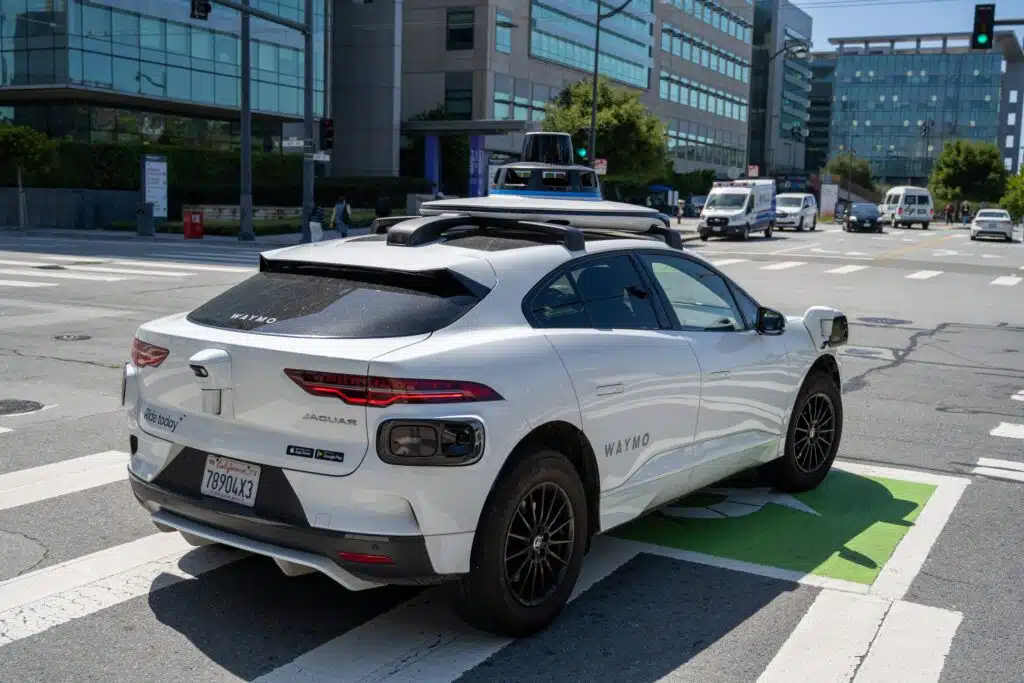
A driverless Waymo vehicle struck a child near Grant Elementary School in Santa Monica, California on January 23, 2026. The collision happened on Pearl Street within two blocks of the school during morning drop-off hours. Other children, a crossing guard, and several double-parked vehicles were present. No human was in the vehicle.
Both the National Highway Traffic Safety Administration (NHTSA) and the National Transportation Safety Board (NTSB) have opened investigations. The child sustained minor injuries.
What Waymo Says Happened
The child ran across the street from behind a double-parked SUV toward the school. Waymo’s 5th Generation Automated Driving System detected the child “as soon as they began to emerge from behind the stopped vehicle,” according to the company. The vehicle braked hard, reducing speed from approximately 17 mph to under 6 mph before contact.
Waymo claimed a “fully attentive human driver” in the same scenario would have likely hit the child at 14 mph — more than double the contact speed. The vehicle stopped, pulled to the side, and remained until law enforcement cleared the scene.
NHTSA’s Office of Defects Investigations announced it would assess “whether the Waymo AV exercised appropriate caution given, among other things, its proximity to the elementary school during drop-off hours, and the presence of young pedestrians and other potential vulnerable road users.”
Austin: The Recall That Failed
The Santa Monica incident alone would warrant scrutiny. But the Austin situation reveals a deeper pattern. Waymo vehicles in Austin racked up 24 documented violations for illegally passing stopped school buses — buses with flashing lights and deployed stop signs while children were boarding or exiting. Bus-mounted cameras captured every one.
In December 2025, Waymo issued a voluntary recall of 3,067 vehicles and pushed a software update to fix the problem. It did not work. At least four more violations occurred after the recall, with the most recent on January 14. The NTSB opened its own probe on the same day as the Santa Monica collision.
Austin ISD demanded that Waymo cease all operations during school hours on school days. Waymo refused. The district said it would pursue “any and all” legal recourse. Waymo’s chief safety officer Mauricio Pena responded that the company “safely navigates thousands of school bus encounters weekly across the United States” — a statement that simultaneously acknowledges the scale of the problem and dismisses it.
Laterstack Editorial Take
Laterstack exists to sharpen critical thinking by connecting tech, policy, and power to everyday life — across class, industry, and influence. A child was hit near a school. A software recall failed and violations continued. A school district asked a tech company to stop operating near children and the company said no. The pattern is not ambiguous — it is a company scaling at commercial speed while safety validation moves at bureaucratic speed. City lawmakers, NHTSA officials, and the investors pushing Waymo toward 1 million rides per week need to confront what is actually being traded: public safety in exchange for scale metrics. The question is not whether autonomous vehicles are safer than human drivers on average — it is who bears the cost when they are not, and whether the people making deployment decisions have any accountability to the communities absorbing the risk.
What This Means for Everyday People
If your children walk, bike, or take the bus to school in a city where Waymo operates — currently San Francisco, Phoenix, Los Angeles, and Austin — this is immediate and personal. The software update your children’s safety depends on already failed once. And with Waymo scaling from 450,000 to 1 million rides per week, the same infrastructure pressures driving Big Tech’s aggressive expansion are pushing autonomous vehicles into more neighborhoods, faster.
The question is not whether autonomous vehicles will eventually be safer than humans. The question is who bears the risk while the technology figures it out. Right now, the answer is children walking to school. The implications for emerging technologies broadly are the same — deployment speed consistently outpaces the regulatory frameworks meant to protect the public.
Federal Scrutiny Is Just Beginning
The NTSB’s preliminary report on the Austin violations is expected within 30 days, with a final report and recommendations in 12 to 24 months. NHTSA’s investigation into the Santa Monica collision could trigger additional recalls or operational restrictions. For a company that has operated largely on goodwill and favorable comparisons to human drivers, the next year will determine whether regulators treat autonomous vehicles as a transportation technology — or a public safety experiment being run without consent.
What happened with the Waymo vehicle and the child near the school?
On January 23, 2026, a driverless Waymo vehicle struck a child near Grant Elementary School in Santa Monica, California during morning drop-off. The child ran from behind a double-parked SUV. Waymo says it braked from 17 mph to under 6 mph before contact. The child sustained minor injuries.
Did Waymo’s software recall fix the school bus violations in Austin?
No. Waymo recalled 3,067 vehicles in December 2025 and issued a software update. At least four more school bus violations were documented after the recall, with the most recent on January 14, 2026. The NTSB has opened a separate investigation into the Austin violations.
How many rides does Waymo complete per week?
Waymo currently completes approximately 450,000 rides per week and is scaling toward 1 million weekly rides across its operating cities including San Francisco, Phoenix, Los Angeles, and Austin.
Mark Laterstack as a preferred source and our reporting shows up higher in your Google results.