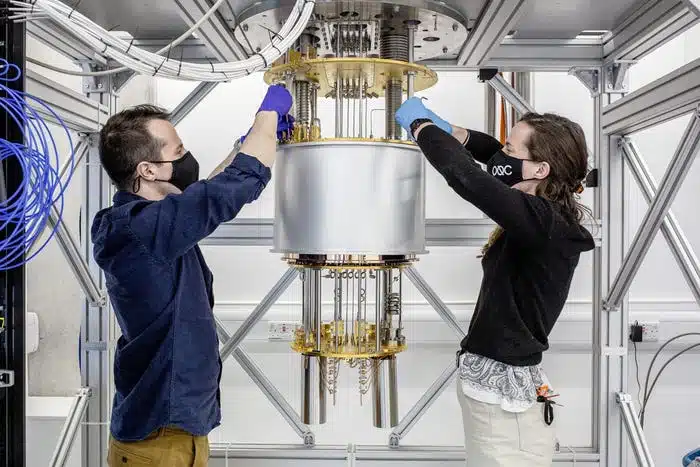
Quantum technology has always been hard to explain. It deals with particles so small and strange that even experts struggle to describe what is happening. Yet behind the complexity lies a truth that is starting to surface. Quantum might soon become as transformative as artificial intelligence and possibly even bigger.
The field that once lived only in theory is now moving into hardware. Companies like Microsoft, Google, and Quantinuum are racing to build quantum computers, sensors, and communication systems. Microsoft’s latest Majorana chip is one example, designed to make quantum systems more stable and less error-prone.
For years, AI dominated the headlines. It was easy to understand, easy to use, and quick to deploy. Quantum, on the other hand, required labs, lasers, and near absolute-zero temperatures. But things are changing fast.
Researchers are finding ways to build qubits, the core building blocks of quantum computers with synthetic diamonds, allowing them to work at higher temperatures and with greater efficiency. Companies like Element Six, a subsidiary of De Beers, are now creating industrial-grade quantum diamonds in partnership with Amazon Web Services, paving the way for more accessible hardware.
The potential scale is enormous. Analysts at McKinsey project the quantum sector could reach 97 billion dollars by 2035. That is still smaller than AI’s trillion-dollar forecast, but the real measure is not in money, it is in impact.
Professor Sir Peter Knight of Imperial College London describes it simply: “Problems that would take the age of the universe to solve could one day be computed in seconds.”
That kind of power could change everything from drug discovery to energy systems. In healthcare, quantum computers could map endless combinations of molecules to design precise, personalized medicines. Google’s new Willow chip already demonstrated how a quantum processor could solve a problem in five minutes that would take the world’s fastest supercomputer ten septillion years.
The same capability could transform global industries. Airbus is testing quantum algorithms to load cargo more efficiently, saving thousands of kilos of fuel. The UK National Grid is investing in quantum models to optimize how power flows across thousands of generators. Even navigation could change, researchers at Imperial College London recently tested a quantum compass that works underground where GPS fails.
These breakthroughs are not limited to science. They also touch national security. Experts warn that quantum systems will eventually break today’s encryption standards, unlocking everything from government secrets to personal data. This looming moment is known as Q-day, when a fully operational quantum computer becomes powerful enough to decrypt traditional systems.
Governments and tech firms are already preparing. Apple and Signal have rolled out post-quantum encryption keys designed to withstand these future attacks. But older encrypted data remains vulnerable. Intelligence agencies are already harvesting and storing data they cannot yet read, waiting for the day quantum decryption becomes possible.
Professor Alan Woodward of the University of Surrey calls it “harvest now, decrypt later.” Once Q-day arrives, everything encrypted by older systems could become transparent overnight.
Still, many experts believe quantum’s benefits will outweigh its risks. Quantum sensors already enable more precise brain scans, helping doctors study movement disorders and childhood epilepsy without keeping patients still. In transportation, quantum navigation could keep airplanes and subways connected even when satellite signals drop.
As Rajeeb Hazra, CEO of Quantinuum, told the BBC, “We as consumers will touch the impacts of quantum computing in almost every walk of our lives. It could be as big as AI — if not bigger.”
The question is no longer whether quantum works. It is how soon we will be ready for it. The technology that once lived in cold labs is warming up fast. And when it arrives, the world may have to rethink not only how we compute, but how we secure, measure, and even understand information itself.
Read the original report by Zoe Kleinman at BBC.
For more Laterstack analysis, explore Quantinuum Helios quantum computer could bring quantum breakthroughs closer to real life and NVIDIA just built the bridge between quantum and classical computing.
Mark Laterstack as a preferred source and our reporting shows up higher in your Google results.