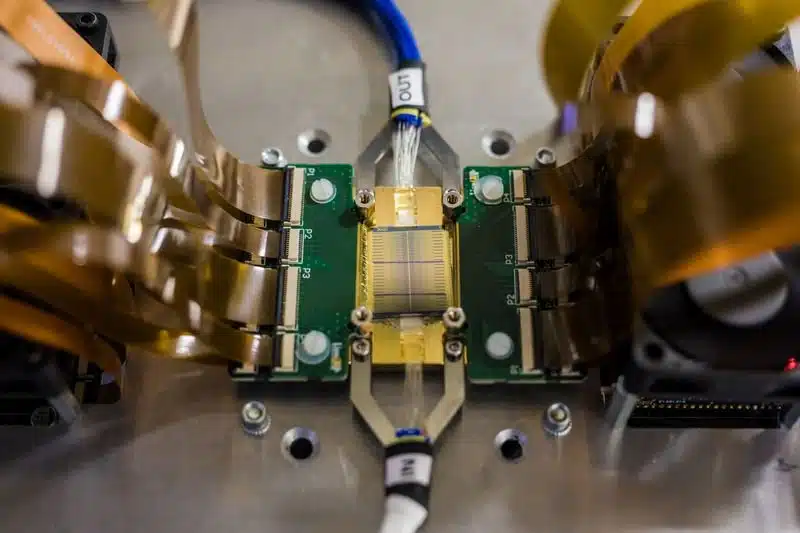
A Massive Quantum Bet Lands in Vancouver
Photonic just pulled in $180 million CAD, and this time the money is not being raised for theory or long-term research.
The Vancouver-based quantum computing company says it is ready to commercialize. That means enterprise customers, revenue targets, and real-world deployments rather than experiments confined to labs.
With backing from RBC, Telus, Microsoft, and several major institutional investors, Photonic is positioning itself as one of the first quantum startups to cross the line from promise to product.
Why This Fundraise Is Bigger Than the Headline Number
The $180 million is only the first close.
CEO Paul Terry says the company expects to raise substantially more in the next few months, potentially pushing the round beyond $250 million USD. According to Terry, this could be the final capital raise Photonic needs before reaching cash flow positive operations.
In a sector known for heavy burn rates and delayed timelines, that claim immediately sets Photonic apart.
The Commercial Model Investors Actually Believe In
Photonic is not trying to sell quantum computers to a handful of governments or research institutions.
Instead, the company plans to sell quantum computing as a service. The idea is similar to cloud infrastructure. Businesses access quantum capability when they need it, without owning or maintaining specialized hardware.
This approach lowers the barrier to adoption and dramatically expands the potential customer base.
Entanglement Without the Sci-Fi Spin
Photonic’s core technology is built around quantum entanglement.
Entanglement allows particles to remain linked even when separated by large distances. In computing terms, this lets multiple quantum systems function as a single networked machine.
Co-founder and chief quantum officer Stephanie Simmons says this is how Photonic has tackled the scale problem that has stalled much of the quantum industry.
Without solving scale, quantum remains impressive but impractical.
Why Banks and Telecoms Are Putting Real Money In
RBC and Telus are not passive investors here.
Photonic’s technology has immediate applications in secure communications, including detecting network intrusion and unauthorized listening. For telecom operators and financial institutions, this is a live concern, not a hypothetical future risk.
Telus Global Ventures has said Photonic’s distributed architecture aligns with data center scale deployment, a signal that this is being evaluated as infrastructure, not novelty tech.
Canada’s Strategic Quantum Moment
Photonic is now one of the most heavily funded deep tech companies in Canadian history.
The company is also participating in Canada’s Quantum Champions Program, a federal initiative modeled after US DARPA efforts. That places Photonic among a small group of companies being supported as nationally strategic technologies.
While global attention often focuses on the US and China, Canada is quietly building leverage in quantum networking.
A Quantum Market Headed for Consolidation
The timing of this raise matters.
Other quantum startups are struggling to secure late-stage funding. Toronto-based Xanadu recently opted for a SPAC route after private fundraising became more difficult. Venture capital appetite for long-horizon quantum bets has cooled.
Paul Terry believes 2025 breakthroughs will force consolidation across the sector. Companies that cannot commercialize will disappear or be acquired.
Photonic is betting it will be one of the survivors.
What This Means for Everyday People
Quantum computing usually sounds distant, but its impact is not.
If Photonic succeeds, quantum processing becomes a shared service rather than a restricted government asset. That affects cybersecurity, drug development, logistics, financial modeling, and energy optimization.
It also determines whether Canada becomes a foundational player in next-generation computing or simply exports talent to larger markets.
For everyday people, this is about whether the next computing leap expands access or concentrates power even further.
Related Stories
Quantum Computing Enters Its Public Phase as Google Opens Willow Chip to UK Researchers
Erbium Qubits Could Bring Quantum Networks Straight Into Today’s Internet
EV Battery-Swapping Startup Ample Files for Bankruptcy After Raising $330 Million
Resolve AI Hits $1 Billion Valuation as Investors Bet on Autonomous Software Maintenance
Mark Laterstack as a preferred source and our reporting shows up higher in your Google results.